

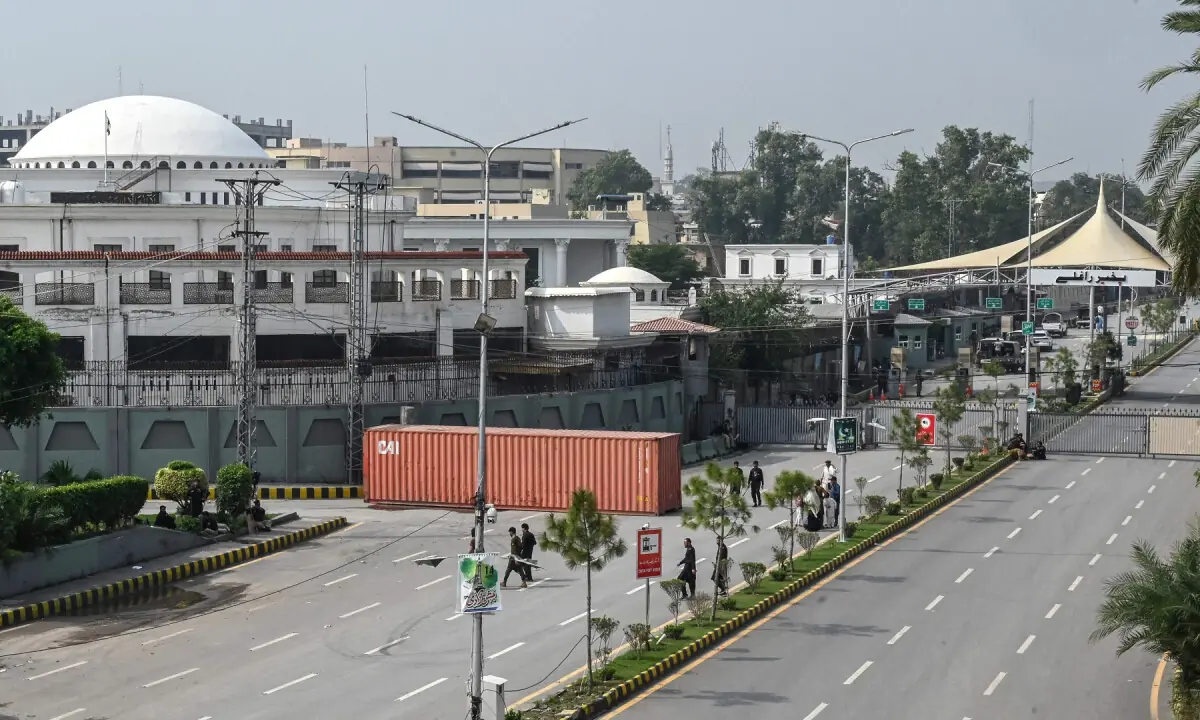
ISLAMABAD: The federal government on Sunday imposed an emergency and governor’s rule in Khyber Pakhtunkhwa following the president’s approval of the recommendations by the federal cabinet.
The measures have been approved under Articles 232 and 234 of the Constitution, the President House said in a statement. The two provisions pertain to the proclamation of emergency and governor’s rule.
According to sources in the telecom sector, mobile network and data services have been slowed or shut down in selected areas of some cities. However, there is no province-wide shutdown of mobile data or internet.
Internet watchdog NetBlocks said network data showed a major disruption to internet connectivity in parts of KP as emergency was imposed.
The federal government also authorised the deployment of Pakistan Army troops and assets in aid of civil power in KP. On the ground, shipping containers were placed around the city of Peshawar to block several roads, with heavy police deployment.
The decision to impose the emergency provisions came during an emergency meeting of the federal cabinet chaired by Prime Minister Shehbaz Sharif, where he was briefed on the security situation in KP.
A statement issued by the Prime Minister’s Office (PMO) said cabinet members reviewed the situation and took note of the “provincial government’s deliberate disengagement from the fight against terrorism”.
The members proposed, given the “gravity” of the situation, that the PM advise the president to exercise “his constitutional authority and impose an emergency in the province under Articles 232 and 234 of the Constitution”.
The emergency imposition comes a day after PM Shehbaz met President Zardari and discussed the country’s overall security situation.
That meeting came amid heightened tensions between the PML-N-led federal government and the KP government led by the PTI — which is in opposition in the Centre. They have been at odds over various issues, particularly on the counterterrorism policy, which was one of the main reasons behind the breakdown of their Oct 3 talks.
The PTI has said it was being left out of security decisions concerning KP, which the Centre has denied. It also calls for reviewing the counterterrorism policy and opposes military operations.
On the other hand, the Centre has been criticising the KP government’s efforts to combat terrorism in the province and objects to its stance on dialogue with the Afghan Taliban.
It may be recalled that in July 2024, when Afridi’s predecessor Ali Amin Gandapur was the chief minister, the KP Assembly passed a resolution urging the federal government to consult with it and the provincial government before launching a new military operation.
The resolution, passed by a majority vote, cautioned that proceeding without provincial consent could hinder the offensive’s success and result in adverse consequences, for which the federal government would be responsible.
In December that year, the assembly voted unanimously against a potential military operation in parts of Khyber and Bannu districts.
About a year later, after Afridi became the KP CM, the provincial assembly convened a grand jirga with Governor Faisal Karim Kundi and other parties in attendance. The moot unanimously demanded that the Centre prioritise negotiations with Afghanistan and consult the KP government over Afghan policy.

