

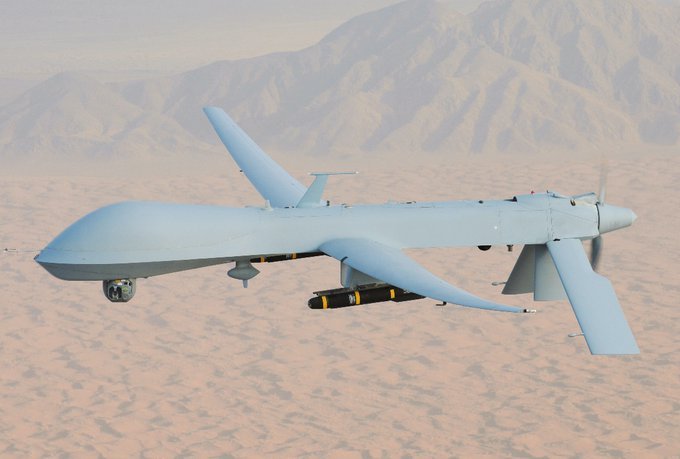
TEHRAN: Iran’s Islamic Revolutionary Guard Corps (IRGC) announced that it had shot down a US MQ-1C ER drone over the eastern Strait of Hormuz, marking the 20th such drone downed and the fourth in 24 hours, PressTV reported on Sunday.
A senior Iranian commander said, “They wanted to change the Islamic Republic, but they themselves changed,” PressTV reported.
Meanwhile, Iran’s Secretary of the Supreme National Security Council, Major General Rezaei, said Iran in 2026 was not the same country that attended the 1943 Tehran Conference or the 1945 Yalta Conference, PressTV reported.
He also said the US was no longer the America of that era, describing it as a “defeated nation, not a victorious one”.
“The world has changed. You cannot restore the old world order with outdated photographs!” he added.
IRGC Commander-in-Chief, Major General Ahmad Vahidi, also warned that any violation of the country’s airspace will be met with a “firm and decisive response”, PressTV reported.
In a post on X, Vahidi described Iranian airspace as a red line for the country’s Armed Forces, stressing that any breach would prompt a strong response.
Separately, Iranian President Masoud Pezeshkian said the country was facing a “silent economic war”, which he described as even more challenging than a military conflict, Al Jazeera reported.
Iran’s Agriculture Minister Gholamreza Nouri said the country’s food reserves remained higher than in previous years despite pressures caused by the war. He ruled out bread rationing and price increases for the time being, Al Jazeera reported.
Iran accuses Trump of fabricating drone figures to conceal US military losses
Iran’s Deputy Parliament Speaker Hamidreza Hajibabaei has accused US President Donald Trump of fabricating figures related to Iranian drones in an attempt to conceal American military losses, Al Jazeera reported.
Bahrain demands UN action, compensation for Iranian attacks
Bahrain demanded early on Sunday that Iran be held accountable and pay full compensation for attacks on the kingdom, urging firm action by the UN Security Council.
In a statement, the Foreign Ministry rejected Tehran’s justification for the attacks, saying that an industrial facility recently hit was civilian.
It accused Iran of using disputes with other countries as a pretext to attack Bahrain, endanger civilians. and violate the Gulf state’s sovereignty.
Bahrain reserves the right to defend itself, alone or with its allies, at a time and place of its choosing, said the ministry.
US-Iran deal vital to easing global financial crises: Turkish foreign minister
Turkish Foreign Minister Hakan Fidan said on Saturday that a potential agreement between Washington and Tehran carries critical weight for alleviating global economic strain beyond reopening the Strait of Hormuz.
“Hopefully it will succeed. We are also doing everything we can. A US-Iran agreement is not only important for opening the Strait of Hormuz. In fact, it is important in the sense of rolling back global financial crises somewhat,” Fidan told Turkish broadcaster TGRT Haber.
Warning that the fallout from the Iran war threatens international markets, Fidan said: “The economic burden brought by this war and lack of resolution is getting harder every day for many countries. It is heading toward having very destructive effects.”
He said diplomatic efforts around the Strait of Hormuz, a strategic waterway vital to global energy shipments, remain active, with messages and demands passing between the parties even though the process currently seems deadlocked.
Confirming that mediation efforts are continuing, Fidan noted that he recently discussed the crisis with Qatari Prime Minister and Foreign Minister Mohammed bin Abdulrahman Al Thani.
Fidan also outlined a two-track framework for addressing disputes involving Iran, arguing that questions surrounding Tehran’s nuclear program can be handled within the US and UN frameworks.
Other regional issues tied to Iran, however, should be addressed directly by regional countries rather than outside actors, he said.
Saying that in the past resolving regional disputes was left to hegemonic powers, Fidan stressed the importance of regional states developing the political will to find solutions to their own problems.

