

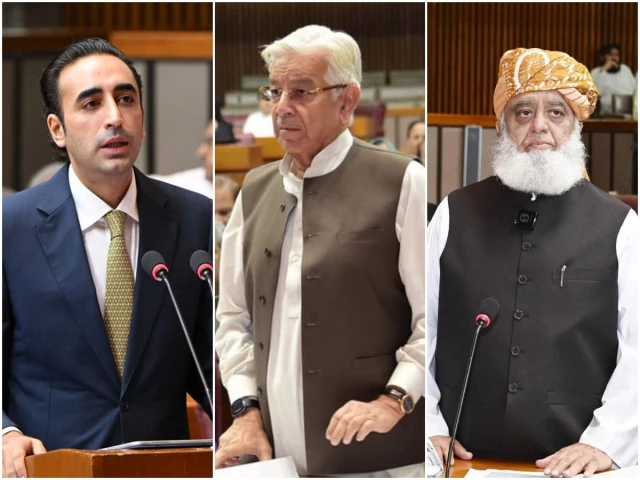
ISLAMABAD: Pakistan Peoples Party (PPP) Chairman Bilawal Bhutto Zardari and Jamiat Ulema-e-Islam-Fazl (JUI-F) chief Fazlur Rehman criticised Defence Minister Khawaja Asif over his remarks about Azad Jammu and Kashmir (AJK) during a heated session of the National Assembly on Wednesday.
In a television interview, Asif said Rawalakot — which has seen protests led by the Joint Awami Action Committee (JAAC) — was “not Kashmir” and that he did not regard its residents as Kashmiris. He later clarified the remarks on X, saying that “Kashmiriat is defined by the sacrifices and struggles waged over almost eight decades” by Pakistanis, Kashmiris and others, “not by birth certificates”.
While addressing the NA during debate on the federal budget, Bilawal said, “There are certain ministers whose politics I do not understand. Instead of helping the prime minister, they create problems for him.”
The PPP chairman went on to say that every coalition partner, every member of the opposition and every citizen of Pakistan should ask “why such a minister is still in the cabinet,” he said, adding: “How is it possible for us to accept that a federal minister can say that the Kashmiris of Rawalakot are not Kashmiris?”
Bilawal said Pakistan’s political parties needed to work together at a time of significant regional and international change. “Where Pakistan stands today, and given everything that is happening geopolitically, if all political parties unite and decide that we will collectively confront Pakistan’s challenges, then we can secure the political, economic and strategic dividends that these opportunities offer,” he said.
The PPP chairman said PM Shehbaz wanted to move the country forward in consultation with coalition partners and the opposition, arguing that many national problems could only be resolved through dialogue. “Problems can only be solved through negotiations and dialogue,” he said.
Bilawal said criticism of statements made at rallies or protests was legitimate, but argued that the comments of a serving federal minister carried a different weight. “If he is not prepared to apologise, then what justification do we have for sitting alongside that minister?” he asked.
While expressing respect for PM Shehbaz, Prime Minister’s Adviser on Political Affairs Rana Sanaullah and former prime minister Nawaz Sharif’s longstanding association with the Kashmir cause, Bilawal said a minister’s remarks had worsened an already sensitive situation.
“Instead of extinguishing the fire, it was like pouring oil on it,” he said.
Bilawal also referred to remarks allegedly made by a minister regarding AJK elections, saying such statements had provided political space for unrest. “If a minister says that we bring 12 seats in our pocket, then how can we object when people react to such statements?” he said.
Calling for a political solution to the dispute, Bilawal suggested: “As your coalition partner, is that we should give Maulana Fazlur Rehman the space to engage with the federal government, the AJK government and the protesters so that this process reaches a conclusion and the people of Kashmir do not have to protest again and again.”
He said all stakeholders should pursue “a political path” that would help protect the Kashmir cause while easing tensions.
The PPP chairman then turned his attention to local government issues, particularly in Karachi, accusing some members of the federal coalition, specifically Muttahida Qaumi Movement Pakistan (MQM-P), of misleading their allies and directing criticism towards the PPP instead of addressing grievances within the federal government.
“Your problem is not with the PPP,” he said, addressing lawmakers from Karachi. “The people creating problems for you are your own cabinet colleagues.”
He alleged that coalition partners were being offered “lollipops” instead of meaningful solutions and urged them to hold federal ministers accountable for unfulfilled commitments.
“How long will you continue to survive on lollipops?” he asked.
Bilawal defended the PPP government’s record on local government, arguing that Sindh was currently the only province where a functioning local government system was in place. “Where the PPP is in government, there is a local government system. Where the PML-N is in government, they are afraid even to hold a union council election,” he said.
He challenged political opponents to implement in Lahore the same local government model that existed in Karachi and called for local government elections to be held in Punjab and Islamabad before any constitutional amendments were considered.
The PPP chairman also pledged that local government elections would be held in Gilgit-Baltistan within 90 days if a new government was formed there with PPP participation.
Concluding his speech, Bilawal urged lawmakers to pass the budget before Ashura and avoid unnecessary political confrontation. “I also want the prime minister to succeed because if the prime minister succeeds, Pakistan succeeds,” he said.
“In my personal view, this is not the time to focus on our political differences. This is the time for us to unite and find solutions to Pakistan’s problems.”
Maulana Fazlur Rehman
The JUI-F chief also addressed the house and criticised the government’s handling of the situation in AJK, questioned remarks made by the defence minister and warned against what he described as the political involvement of state institutions.
Fazl said he had responded to a letter from the JAAC through a video message and had also informed the government of his position. “I welcome the decision of the Awami Action Committee to postpone tomorrow’s march towards Muzaffarabad,” he said, referring to planned protests in AJK.
The JUI-F chief questioned the state’s response to recent developments, asking, “How can action taken on the basis of speeches be considered an appropriate response?” “Until yesterday, we were speaking about human rights in Indian Illegally occupied Jammu and Kashmir (IIOJK). What are we doing today?” he added.
“The things Khawaja Asif has said should not have been said by a defence minister,” he told lawmakers. In an apparent reference to the government’s approach to the crisis, he remarked, “You have entrusted the conflict to Khawaja Asif and the reconciliation to Ishaq Dar.”
While acknowledging the government’s diplomatic efforts abroad, Fazl argued that, “At the international level, the government is earning goodwill through efforts for global peace, but Pakistan is losing goodwill at home,” he said.
The JUI-F chief also criticised the use of security forces in internal matters, saying, “Pakistan’s army should be on the borders; instead, it is being used within the country.”
He warned that statements such as those made by the defence minister would only inflame tensions. Fazl also pointed to his party’s recent public gathering in Charsadda, claiming it had attracted hundreds of thousands of people.
Addressing the role of institutions in politics, the JUI-F chief said his party respected the military, the establishment and all state institutions, “But if they change election results, then we will respond.”
“If they engage in politics, we will answer them in politics,” he added. Fazl rejected calls for silence on such matters, saying, “We are not mute. We will not become silent devils.”
He further argued that if institutions used taxpayers’ money for political purposes, elected representatives had a duty to raise the issue in parliament.
Rana Sanaullah
Addressing the NA, PML-N leader Rana Sanaullah outlined the federal government’s negotiations with the JAAC, stating that all 38 developmental demands presented by the committee, alongside their two primary demands, had been addressed.
He recalled that the JAAC’s two main demands were the supply of electricity to AJK at the generation rate, as stipulated in the agreement with the government of Pakistan upon construction of the Mangla Dam, and subsidies on wheat. PM Shehbaz accepted both demands, Sanaullah said, adding that electricity in AJK was currently priced at Rs3.50 per unit while wheat was subsidised at Rs2,000 per maund.
The 38 additional demands, Sanaullah said, ranged from road and bridge construction and the establishment of a military base to the supply of MRI machines to hospitals. He said the prime minister had also provided Rs10 billion to overhaul the electricity system, which was currently underway.
“Out of the 38 demands, not a single one did not work. All their demands, which were related to the development and construction of Azad Kashmir, the public welfare demands, we sat with all of them and discussed each of their demands,” he said.
On the JAAC’s demand for the abolition of the 12 seats reserved for immigrants in the AJK Legislative Assembly, Sanaullah said a six-member committee was constituted — comprising two members each from the JAAC, the AJK government, and the federal government — to present recommendations to the AJK government.
However, he said the JAAC boycotted the committee from October 2025 onwards and refused to engage further. “This is not something that can be solved in a protest,” he said.
Further, Sanaullah said that when it became apparent that elections in AJK were scheduled for July, the JAAC announced a long march for June 9, with the stated aim of halting the elections. Following this, the prime minister directed the same negotiating committee to re-engage.
A fresh round of talks was held in Muzaffarabad over two days, attended by the chief secretary of AJK and Prime Minister Faisal Rathore, at which progress on all 38 points was presented and acknowledged by the JAC itself, he said.
On the immigrant seats issue, Sanaullah said the assembled political leadership, including PML-N and PPP representatives, argued that abolishing these seats or stripping immigrants of their rights would undermine the fundamental purpose of the committee’s movement.
He said the government’s position was that the matter should be taken to the AJK Legislative Assembly for a decision. “Whatever it considers appropriate, they will decide on it. They said, no, we don’t agree to this,” Sanaullah stated.
The government subsequently offered three alternative paths for resolution: an All Parties Conference whose decision would be taken to the Assembly; a presidential reference to the Supreme Court’s full bench; or a debate within the assembly itself. The JAAC refused all three, he said.
When the government asked the JAAC to postpone the June 9 long march until after the elections, and then by at least 10 days to allow for one of the three proposed processes to proceed, the JAAC refused both requests. “They said that at any cost, on June 9, they will come to Muzaffarabad,” Sanaullah said.
Despite this, he said, an All Parties Conference was held in AJK, attended by all political parties and led by Rathore.

