
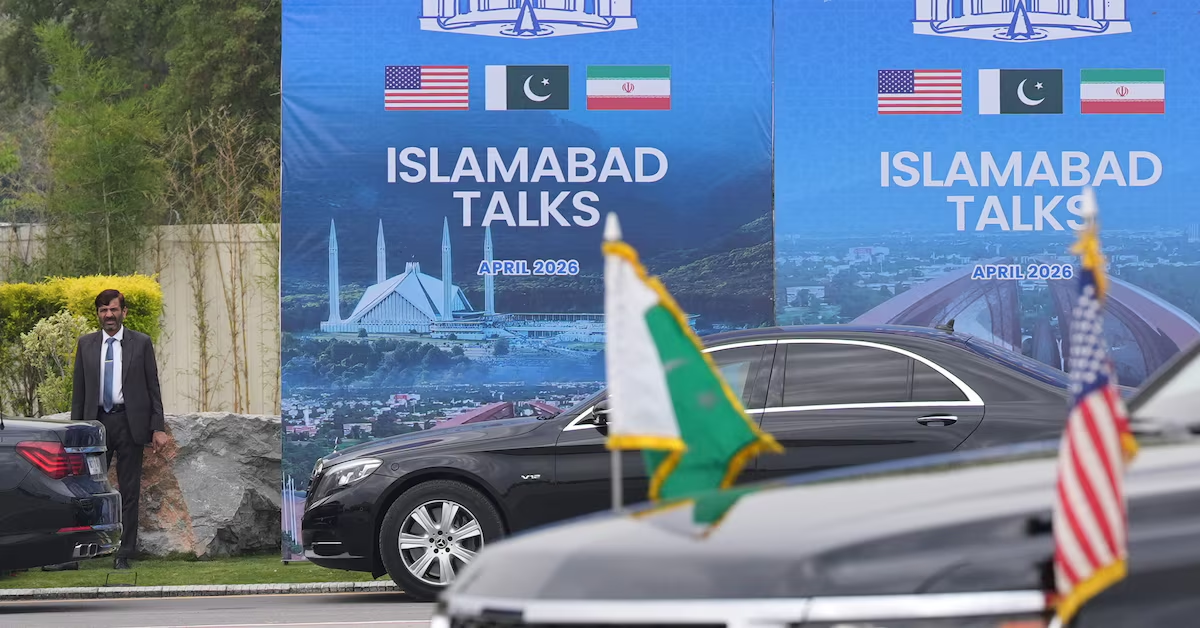
ISLAMABAD: Prime Minister Shehbaz Sharif said on Friday that the “final, agreed upon text” of the peace deal between the United States and Iran had been reached, adding that Pakistan was working with both sides to finalise the next steps.
“Amid ongoing intense mediation efforts by Pakistan, we are fully aware of incessant misinformation campaign being waged by those who want to sabotage the peace deal. Setting aside the noise, we can confirm that a final, agreed upon text of the peace deal has been reached and Pakistan is now working closely with both sides to finalise the next steps. Peace has never been this close as it is now,” he said in a post on X.
Iranian Foreign Minister Abbas Araghchi said earlier that the proposed Islamabad Memorandum of Understanding between the Islamic republic and the United States was closer than ever to being finalised.
“The Islamabad Memorandum of Understanding has never been closer,” Araghchi said in a post on X.
He urged the media to refrain from speculating about the contents of the agreement while negotiations are still ongoing.
“Pending its finalisation, the media should refrain from entering speculation about its content,” he wrote.
Araghchi said details of the memorandum would be made public once the process is completed.
“In line with our responsible and transparent approach, all details will be shared with the public in due course,” he added.
Meanwhile, a White House official told Anadolu that Iran had agreed to a “performance-based deal” with the US, which would require concessions on Tehran’s part before receiving any sanctions relief.
As part of the deal, the official said, Iran’s nuclear material would be destroyed and removed, its nuclear programme would be dismantled, and “none of their money released until they perform”.
The official also said that the Strait of Hormuz would remain open and Iran would agree to stop funding “terrorist groups”.
“This is what they have agreed to. This is a performance-based deal,” the official added.
Trump says Iran’s leaked deal terms are untrue
United States President Donald Trump said on Friday that Iran’s leaked comments on a deal with the US did not represent what has been agreed to in writing.
“What they said, including their weak and pathetic statement on having a deal, bears no relation to the truth. Very dishonourable people to deal with. With them, there is no such thing as dealing in good faith. Amazing!” he wrote on Truth Social.
“They better get their act together, and fast!” Trump said.
Trump said on Thursday he was calling off new strikes on Iran because a deal had been reached.
Terms of the deal as described earlier today by Iranian officials appear to offer Tehran much of what it has demanded so far, with Trump appearing to win little of what he has sought, beyond the reopening of the Strait of Hormuz, which Iran shut after he ordered attacks in February.
A senior Iranian source told Reuters that the draft would waive sanctions on Iran’s oil, unfreeze billions of dollars of its funds and require a cessation of hostilities on all fronts, including in Lebanon.
Nuclear issues would be set aside for later talks. Washington wants a deal to ensure that Iran never develops a nuclear weapon; Iran says it is not seeking one.
The waiving of sanctions, unfreezing of Iranian assets and halt to Israeli attacks on Lebanon are essential Iranian demands. The source made no mention of what Iran might offer in return.
A Western source told Reuters that the memorandum between the US and Iran to halt the war in the Gulf could be signed as soon as Sunday with Geneva emerging as the likeliest venue.
The source said language in the memorandum was still being finalised and Iran was sticking to its position that the deal must also end fighting in Lebanon, where Israel has been bombing Lebanon’s civilian infrastructure while saying they are in a fight against Hezbollah.
The aim was to finalise the wording by Saturday so the agreement could be signed by US Vice President JD Vance and Iran’s Parliament Speaker Mohammed Bagher Ghalibaf. No venue had been established, but Geneva was emerging as the likeliest.
Iran’s Mehr news agency said the terms also included other key US concessions, including a commitment to withdraw its forces from around Iran and present a plan for rebuilding the shattered Iranian economy.
“The United States and its allies must submit plans for Iran’s reconstruction worth at least $300 billion,” the Mehr report said.
The report also cited a diplomat briefed on the matter as saying that Iranian negotiators had agreed to a deal, though it remained unclear whether it had been approved by Supreme Leader Mojtaba Khamenei, who has final authority over major foreign policy and military decisions.
Israeli Prime Minister states that he will not let Iran have nuclear weapons
Israel’s Prime Minister Benjamin Netanyahu stated on Friday on X that “as long as” he is the PM, “Iran will not have nuclear weapons.”
“There is full agreement between me and President Trump on this issue.”
He further claimed that for “30 years, I have been at the forefront of the international campaign against Iran’s nuclear program,” adding that were it not for him, “Iran would long ago have had atomic bombs to destroy Israel.”
Iran has repeatedly denied seeking nuclear weapons.
Iranian media reveals details of 14-point draft memorandum with US
Iranian media on Friday published the details of a 14-point draft memorandum of understanding between Tehran and Washington, revealing significant differences from provisions previously reported by Axios regarding sanctions relief, frozen Iranian assets, reconstruction commitments, and the scope of future negotiations.
According to Mehr, the draft has 14 points and remains subject to final review and approval by relevant Iranian authorities.
The two reported versions share several key elements, but significant differences emerge in how those objectives would be implemented.
Axios reported a 60-day “extension” of the existing ceasefire, including in Lebanon, while nuclear negotiations continue.
The draft published by Mehr instead calls for an “immediate and permanent” cessation of hostilities on all fronts, including Lebanon, followed by 60 days of negotiations toward a final nuclear agreement.
The two accounts also differ on the reopening of the Strait of Hormuz. Axios reported an “immediate” reopening of the strategic waterway without tolls and restoration of normal shipping volumes. The Iranian-reported draft stipulates reopening the strait within 30 days and in coordination with Iran.
Sanctions relief represents another major point of divergence.
According to Axios, US sanctions relief would be linked to Iranian compliance with the agreement. The draft published by Mehr goes significantly further, calling for suspension of sanctions on Iranian oil, petrochemical products, and derivatives, full access to Iran’s financial resources, and eventual lifting of all primary and secondary US sanctions, as well as related measures imposed through the UN Security Council and the International Atomic Energy Agency’s Board of Governors.
The treatment of frozen Iranian assets also differs substantially.
Axios reported that Iran could gain access “to some” frozen funds for humanitarian purchases through a mechanism discussed with Qatar. By contrast, the draft published by Mehr calls for the release of $24 billion in frozen Iranian assets during the 60-day negotiating period, with half of the funds to be made available before final negotiations begin.
Another major difference concerns reconstruction and post-war guarantees.
While the Axios report did not refer to reconstruction assistance, the draft published by Mehr states that the US and its allies would be required to present plans for rebuilding Iran worth at least $300 billion.
The Iranian-reported draft also includes several provisions not mentioned in the Axios account, including a US commitment not to interfere in Iran’s internal affairs, respect for Iranian sovereignty, and withdrawal of US forces from areas surrounding Iran.
It also includes a US pledge not to increase military deployments in the region and not to impose new sanctions during negotiations.
On the nuclear issue, the two versions overlap to some degree.
IRNA reported that under the current MOU, Iran makes no commitment regarding the transfer of management of the Strait of Hormuz, and the future of its management will be undertaken by a joint decision-making framework between Tehran and Oman.
Axios reported a framework for addressing Iran’s enriched uranium stockpile, with further nuclear measures contingent on a follow-up agreement. The draft published by Mehr states that Iran would reaffirm its commitment under the Nuclear Non-Proliferation Treaty not to produce nuclear weapons.
Perhaps the most consequential difference concerns the scope of future negotiations.
According to the draft published by Mehr, the final agreement would be limited to enriched nuclear material, enrichment activities, sanctions relief, and Iran’s economic reconstruction program. It explicitly excludes discussions on Iran’s missile program and support for “resistance groups.”
IRNA stated that no agreement is made regarding the nuclear file under the current memorandum, and nuclear talks will take place within 60 days after signing.
The draft further states that any final agreement would be endorsed through a UN Security Council resolution and that a monitoring mechanism would be established to oversee implementation—provisions not mentioned in the Axios report.
Mehr noted that the text still requires review and approval by Iran’s relevant authorities before it can be formally adopted.
A deal to permanently end the US-Israeli war on Iran could be signed as soon as this weekend, President Trump said Thursday, in a day dominated by whiplash developments.
Iran said Thursday that the “main part” of the text of understanding with the US had been finalised, while accusing Washington of undermining progress through shifting positions.
US forces carried out a second day of strikes on Thursday against multiple targets in Iran, following the downing of an Apache helicopter above the Strait of Hormuz.
Iran’s Islamic Revolutionary Guard Corps (IRGC), for its part, said 18 major US military targets had been struck at the Ali Al Salem and Ahmad Al Jaber air bases in Kuwait, Sheikh Isa Air Base in Bahrain, and a base hosting American fighter jets in Jordan.
The latest escalation has heightened regional tensions following US strikes on Iran and Tehran’s subsequent announcement that it was closing the Strait of Hormuz to maritime traffic.
Trump says Iran war deal close as Strait of Hormuz tensions linger
The deal to end the US-Israeli war on Iran, if confirmed, would be the most significant diplomatic breakthrough yet, which has killed thousands in Iran and Lebanon and sent global energy prices sharply higher after Iran all but closed the Strait of Hormuz to shipping.
“We just made a great settlement of the war with Iran,” Trump told reporters at the White House on Thursday.
“The strait will officially open as soon as we sign, which could be soon, very soon, maybe over the weekend in Europe,” he said, adding that Vice President JD Vance would attend the deal signing.
Since mid-March, Trump has repeatedly claimed a deal with Iran to end the war was close. The two sides have traded strikes this week, straining a ceasefire announced in April.
Iranian media reported Foreign Ministry spokesperson Esmaeil Baghaei as saying large parts of the agreement have been finalised, but Iran would not compromise on its red lines.
“We have not reached a conclusion on this matter,” he said. “This is a very important issue that is currently being reviewed by the relevant decision-making bodies.”
Trump says G7 support ‘irrelevant,’ claims ‘victory’ in Iran war
US President Donald Trump has dismissed any support from G7 as “irrelevant” and claimed that “we have won the war in Iran,” in a brief phone interview broadcast by Italian channel La7 on Friday.
Trump made remarks during a call with La7’s Washington correspondent.
Asked whether he had a message for G7 leaders, Trump said the US had not needed external support.
“We didn’t need any support. So, we have won the war. It was a bit irrelevant, irrelevant! I have to go. I’m in an important meeting, but we have won the war in Iran. We didn’t need their help,” Trump said.
The comments came ahead of the G7 summit scheduled for June 15-17.
Regional tensions that began on February 28, after Israeli and US strikes on Iran triggered a cycle of military confrontations, retaliatory attacks and diplomatic disputes.
Iran and Israel also exchanged strikes in recent days before pulling back, highlighting the fragility of a ceasefire and ongoing efforts by regional and international mediators to revive diplomacy and prevent a broader conflict.

