

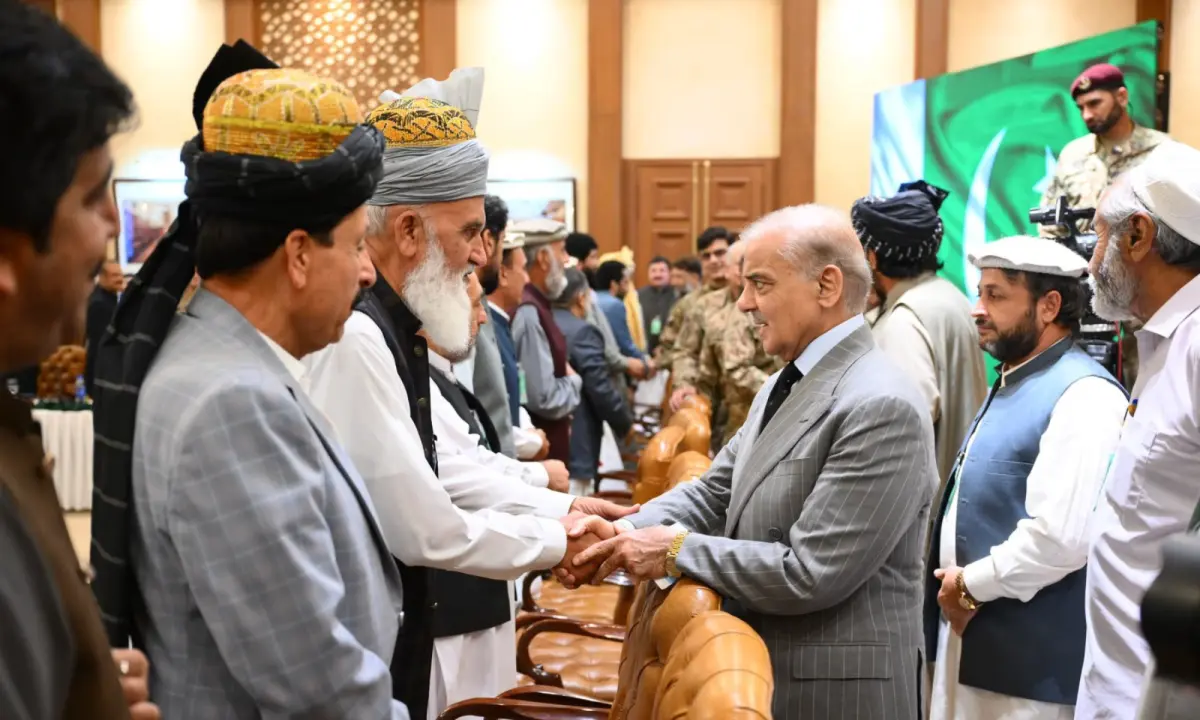
PESHAWAR: Prime Minister Shehbaz Sharif on Thursday vowed that the federal government, which now runs Khyber Pakhtunkhwa under governor’s rule, would make every effort possible to “bring back” progress to the province.
He made the remarks while chairing a meeting of the apex committee in Peshawar, where he arrived earlier in the day on his first visit to the province since the imposition of governor’s rule and the declaration of emergency on Oct 11.
The meeting, attended by Chief of Defence Forces and Chief of Army Staff Field Marshal Asim Munir and KP Governor Faisal Karim Kundi, reviewed KP’s overall security situation. Federal ministers and newly appointed provincial advisers were also present.
Addressing the committee, PM Shehbaz reiterated that emergency and governor’s rule had to be imposed “under extreme compulsion”.
“I promise that we will leave no stone unturned in bringing back the happiness and era of progress to this province, and in the practical realisation of the wishes, aspirations, and dreams of this province’s people that have been shattered due to the worst actions of recent years,” he said.
The prime minister affirmed that the Centre “will place all possible resources at your feet”.
He added that himself, the Advisory Council led by the governor, the president and the CDF “will ensure that this province, once again, not only matches the other provinces in the race for development, but I would be extremely happy if it moves even further ahead”.
The prime minister regretted that “terrorists were summoned back here” after peace had been established, “washing down all sacrifices down the drain”.
“There can be no greater enmity with the country than not honouring and respecting such sacrifices, not holding them in esteem,” he remarked, highlighting that young soldiers left their homes and families to defend their country.
The premier called for an “all-encompassing analysis as to why this happened”, adding that there was “no worse callousness, criminal negligence, and hostility towards the national interest than this”.
He said: “All issues of the people were pushed aside — whether it is education, healthcare, or protecting the lives and property of the people — and [having] matters with terrorists instead. I believe that no other example can be found of such hostility against the country, in terms of their attitudes, detachment, and callousness.”
PM Shehbaz asserted that 5,000 police vacancies were not filled, Safe City projects were yet to be completed, the capacity of the Counter-Terrorism Department (CTD) had not been enhanced significantly, and neither were special measures taken regarding police training.
He recalled that all provinces had agreed at the time of the 2010 National Finance Commission Award that KP, being the front-line region in combatting terrorism, needed ample resources.
“From 2010 to today, more than Rs800 billion in funds have either already been provided or are being provided under this,” he stressed.
“However, not only did it resurface, but the weapons needed to counter terrorism, the required capacity, and the trained officers needed were nowhere to be found.”
While saying he would not go into the details, the prime minister emphasised that he had assured the provincial governments of ex-chief ministers Ali Amin Gandapur and Sohail Afridi of the Centre’s full support in the fight against terrorism.
“But nothing was done regarding this,” he regretted, adding that the government could not remain a “silent spectator” when a “party was stooping to such enmity against the country” and the economy and society were being destroyed.
“Therefore, on this occasion we made this one last effort,” the premier said, referring to the province’s interim handover to the federal government under governor’s rule.
Highlighting the Centre’s efforts to stabilise the economy over the past two and a half years, PM Shehbaz remarked, “It wouldn’t have been possible [without] unprecedented partnership between political and military hierarchy.”
He said the federal government could not remain a silent spectator when “terrorists were roaming around dancing in all areas of KP, and were ruling over some areas in the evening, and collecting extortion” at a time when the stabilisation of Pakistan’s economy was being acknowledged globally.
The prime minister recalled the breakdown of the Oct 3 talks between the Centre and reiterated that his government was “compelled to make this decision” of imposing governor’s rule.
PM Shehbaz remarked that the province was “shattered with wounds due to the circumstances created in the past several years”.
He highlighted the poor law and order situation over the past six years, recalling that security forces and law enforcement agencies had made sacrifices to establish peace in KP.
The premier said there was corruption of Rs100bn in the clean drinking water of the Cities Improvement Project and Rs37bn in the “infamous looting” in the case of the Kohistan District Accounts Office.
He said that “80,000 people were martyred and the [economy] suffered a loss of several hundred billion dollars. Only then, in 2018, was peace completely restored in this country”.
Describing the province as “very beautiful”, the premier expressed his hope that the government “work hard day and night and speedily make it progress towards development and prosperity”.
“This is the province that is the first extremely strong wall of the homeland,” he noted.
Centre announces Rs160bn uplift funds, other measures
PM Shehbaz later also attended a meeting of the Area Representative and Development Council (ARDC) constituted for 12 districts of KP, which face serious security challenges. CDF Munir was also present on the occasion.
The council covers Dera Ismail Khan, Tank, Lakki Marwat, Bannu, Bajaur, Mohmand, Khyber, Kurram, Orakzai, North Waziristan, South Waziristan Upper and South Waziristan Lower. It includes 48 elders and prominent personalities from those districts to ensure local representation.
Addressing the ARDC, the prime minister announced that the federal government would provide KP with Rs160bn for development projects.
Furthermore, to address the wheat shortage in the province, he said the Centre would provide KP “as much wheat as is needed” from the storages of Pakistan Agricultural Storage and Services Corporation (Passco).
“However, there should be no hoarding. And whatever price the Centre provides wheat at, the common man should get wheat at that very price,” the premier emphasised.
He went on to assure the ARDC that the federal government will provide “whatever assistance” in operations and resources is needed to fight terrorism. He also said directives have been issued to bolster the CTD and complete Safe City projects.
PM Shehbaz also asserted that any difficulties in the completion of the federal government’s projects in KP will be resolved, adding that the governor-led administration will address problems in provincial projects.
The prime minister appreciated the tribal elders for always supporting Pakistan unequivocally and said the ARDC now had an “immense responsibility”.
Noting the remarks of ARDC Chairman Shaukatullah Khan, PM Shehbaz said: “He stated that development work is zero, corruption is 100 per cent, and terrorism is at its peak. I completely agree with him.”
The premier referred to weaknesses in the police’s performance, stating that arrests in cases of theft and robbery were not made.
Mentioning examples of corruption, such as the Kohistan scandal, he said: “You will feel great pain and sorrow over how the province’s resources were looted. God willing, this will be fully controlled, and every single penny of your development and prosperity will be delivered to your doorstep.”
Police’s vehicle procurement ban relaxed: Kundi
Separately, in a bid to improve the police’s capabilities amid the current law and order situation in the province, Kundi said he has approved the relaxation of the police’s vehicle procurement ban to ensure personnel have the necessary resources.
In a post on X, Kundi said that in line with the prevailing security landscape in the province, he approved the relaxation of the ban.
“Our [KP police] force stands on the front lines to protect the lives and security of our people,” he wrote.
“In the prevailing law and order situation, ensuring that our officers have the vehicles and resources they need is essential to an effective response to security challenges.”
Kundi added that the restrictions would be loosened “within the approved scope and against funds already allocated in the Police Procurement Plan”.
“This will strengthen operational capacity without placing any additional burden on the provincial exchequer,” he noted.
“Supporting our police is not just a responsibility; it is an investment in the safety of our people and the peace of KP.”
In July this year, the KP government had imposed a ban on the procurement of vehicles except for ambulances; earth-moving machinery; fire trucks; tractors; trucks; buses; passenger vans; prisoner vans; motorcycles; water tankers; rescue and recovery vehicles and boats; and mobile laboratory vehicles, according to an order issued by the KP finance department.
“In case of [an] essential requirement, the chief minister, Khyber Pakhtunkhwa, may relax the ban on [a] case-to-case basis,” the order read.

