

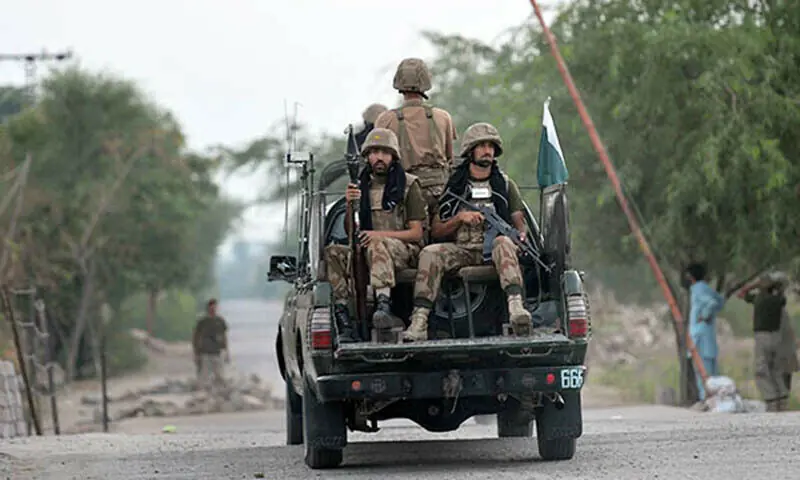
ISLAMABAD: Security forces killed over 20 terrorists during multiple engagements in Khyber Pakhtunkhwa between September 3 and 5, the military’s media affairs wing said on Sunday.
According to Inter-Services Public Relations (ISPR), the slain terrorists were sponsored by India and belonged to Fitna-al-Khawarij — a term the state uses for the banned Tehreek-i-Taliban Pakistan (TTP).
The ISPR statement mentioned an engagement in KP’s North Waziristan on the night between August 31 and September 1. Security forces had initially killed 15 terrorists who were trying to infiltrate into Pakistan through its border with Afghanistan at the time.
Following that, 10 more terrorists holed up in the area were killed, the statement said, adding that a total of 25 terrorists trying to enter Pakistan had been killed in that event.
In another encounter in North Waziristan, movement of another group of terrorists along the Pakistan-Afghanistan border was picked up by the security forces. “Own troops effectively engaged this group of khawarij. As a result of precise and skillful engagement, seven khawarij were neutralised,” the ISPR statement said.
Separately, four more terrorists were killed in two different encounters in Kohat and Dera Ismail Khel during joint operations, according to ISPR.
It said, “These repeated incidents along the Pakistan-Afghanistan border have once again vindicated Pakistan’s persistent stance regarding the abject failure of the Afghan Taliban regime to deny the use of Afghan soil to the terrorist organisation, under their patronage, for cross-border terrorism.
“The Afghan Taliban regime has consistently failed to ensure effective border management and honour its international counter-terrorism obligations.”
The statement added that security forces “remain resolute and unwavering in their commitment to defend the nation’s frontiers”.
“Sanitisation operations are being conducted to eliminate any other India-sponsored kharji found in the area as relentless counter-terrorism campaign under the vision ‘Azm-i-Istehkam’ (as approved by Federal Apex Committee on National Action Plan) by security forces and law enforcement agencies of Pakistan will continue at full pace to wipe out the menace of foreign-sponsored and -supported terrorism from the country,” the statement read.
President Asif Ali Zardari paid tribute to the security forces for the successful engagements, a statement issued by his office said.
“The president commended the professional capabilities of security forces for successful operations against khawarij attempting to infiltrate across the Pakistan-Afghanistan border,” the statement said.
He said that defending the country’s borders and eliminating terrorism were among the government’s top priorities.
President Zardari urged the Afghan Taliban rulers to prevent the use of Afghan soil by terrorists.
KP has been facing security challenges, and according to monthly data compiled by the Pakistan Institute for Conflict and Security Studies (PICSS), mainland KP recorded 54 terrorist attacks last month, marking a 50 per cent increase compared to July.
Meanwhile, the merged districts recorded 54 terrorist attacks in August, marking a 126pc increase.
Meanwhile, Islamabad continues to stress that the Afghan Taliban put an end to the use of Afghan soil by terrorists, particularly for attacks in Pakistan.
Despite recent diplomatic developments suggesting a renewed push to ease tensions between Pakistan and Afghanistan, the Foreign Office on Wednesday remained firm that meaningful progress in relations would depend on the Taliban taking concrete and verifiable action against TTP and other terrorist groups operating from Afghan territory.
The FO spokesperson’s remarks, during a weekly briefing, came amid renewed diplomatic activity, including Chinese Special Envoy Yue Xiaoyong’s visit to Islamabad to revive the Urumqi process aimed at preventing further escalation, and an invitation to Afghan ambassador Sardar Shakeb to speak at the National Defence University.
Islamabad, however, sees little proof that the Taliban have moved beyond containing TTP activities.
The latest UN Analytical Support and Sanctions Monitoring Team report noted that the Taliban had relocated around 2,000 TTP fighters and their families away from areas bordering Pakistan, and that Taliban leader Hibatullah Akhundzada had warned the group against attacks on Pakistan — but also that Taliban support for the TTP continued as the group escalated attacks and expanded its organisational structure.
For Islamabad, relocating terrorists does not amount to dismantling the command, training and logistical networks that remain at the centre of its concerns.

