
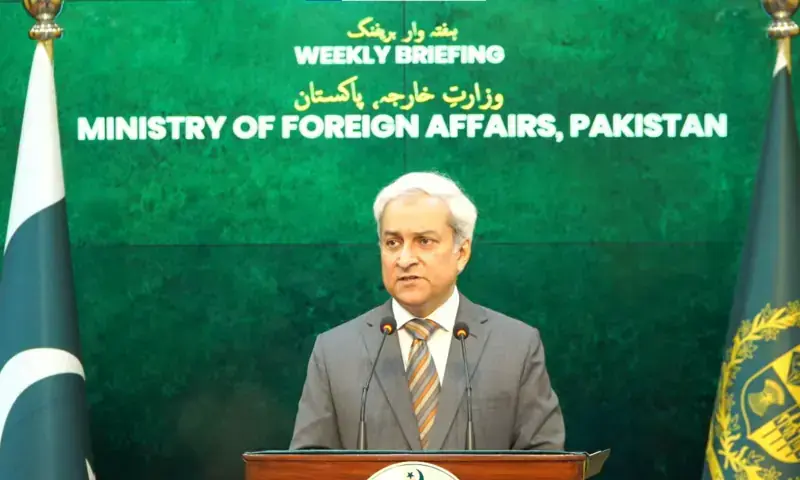
ISLAMABAD: Pakistan on Thursday adopted a measured position on the US campaign of economic pressure against Iran, stressing that it would comply with international law and hoped that economic issues would eventually form part of a wider settlement of the US-Iran conflict.
“About trade with Iran, Pakistan is following international law, and our bilateral trade agreements with Iran,” Foreign Office spokesperson Tahir Andrabi said at the weekly media briefing. “As such, our trade remains in consonance with our obligations.”
The carefully-worded position came two days after the US announced ‘Operation Economic Outcast’, an intensified sanctions campaign aimed at economically strangulating Iran to force it to capitulate after months of military confrontation.
The campaign announced by US Treasury Secretary Scott Bessent expands the risk of secondary sanctions to sectors including shipping, aviation, technology, gold and digital assets. Washington has warned that countries and companies continuing dealings with Iran could face exclusion from the US financial system.
Islamabad, however, avoided directly confronting the US measures, instead anchoring its position in international law and its existing agreements with Tehran.
Pakistan’s formulation also left room for the issue to be addressed through the mediation process it has been pursuing between Washington and Tehran.
“Pakistan hopes that, as part of a wider settlement of the US-Iran standoff, all economic issues will also be settled in the long run, as they form an important part of a viable settlement,” Mr Andrabi said.
“Pakistan remains engaged in its mediatory role in this regard.”
The position reflects the difficult balance facing Islamabad. While US is an important economic partner for Pakistan, Iran is a neighbouring country with strong connections with a segment of its population.
Moreover, the FO’s stance closely echoed the positions taken by China and Qatar on the US move. China had said that its trade with Iran was in the framework of “international law”, while Qatar described the sanctions as unilateral and emphasized on dialogue and a “regional solution”.
The FO spokeperson was more forthcoming about the signs of movement on the Strait of Hormuz, saying Pakistan remained hopeful that recent diplomatic activity could generate momentum towards reopening the vital waterway.
“During the visit of the Chief of Defence Forces Field Marshal Asim Munir, there were indeed renewed efforts for the opening of the Strait of Hormuz,” Mr Andrabi said. “So, we remain positive that some momentum will be generated towards this important aspect.”
The strait has remained at the centre of the wider US-Iran standoff since the breakdown of the Islamabad MoU, which had envisaged its reopening as part of a broader cessation of hostilities and subsequent negotiations.
Pakistan’s renewed engagement came as discussions between Iran, Oman and Qatar on arrangements for navigation through the waterway appeared to enter their final leg.
Mr Andrabi cautioned, however, that the final decision rested with Washington and Tehran.
The Foreign Office also pushed back against reports that Field Marshal Asim Munir had travelled to Tehran “as an envoy of the US president or at Washington’s request”.
“I have very categorically stated that reports alluding to his visit to Iran as an envoy of the US President or at the US behest are quite misleading,” Mr Andrabi said. “So, these reports are not factually correct.”
He said the visit should, instead, be viewed within the context of Islamabad’s own mediation efforts.
“This visit was purely in the context and backdrop of Pakistan’s ongoing role as a mediator, and this is, in essence, how it should be reflected,” he said.
Afghanistan
The FO spokesperson also said that dialogue with Afghanistan remains contingent on definitive action against terrorism, as it made clear that mere assurances from Kabul would not be enough and any bilateral mechanism must produce tangible and verifiable results against groups operating from Afghan soil.
Mr Andrabi said Pakistan had noted Afghan Interior Minister Sirajuddin Haqqani’s proposal for a dedicated mechanism to address contentious issues and remained open to state-level engagement, but stressed that Islamabad had heard assurances before without seeing them translated into effective action.
“However, the sustainability of any mechanism will depend on tangible actions rather than mere assurances,” Mr Andrabi said.
He said Kabul would have to ensure that Afghan territory was not used for attacks against Pakistan and honour its international commitments, including those under the Doha framework. In particular, he named the Tehreek-i-Taliban Pakistan and the Baloch Liberation Army as groups whose activities from Afghan territory remained a major concern for Islamabad.
“We remain ready for institutional coordination, provided it results in tangible and verifiable counter-terrorism measures and effective border management,” he said.
The Pakistani response came after Mr Haqqani proposed a dedicated bilateral coordination mechanism with Pakistan, saying Afghan authorities were prepared to cooperate on information-sharing, border management and the movement of militants. He also suggested a separate mechanism for trade, transit and refugee issues, as prolonged border restrictions have disrupted commercial activity between the two countries.

