
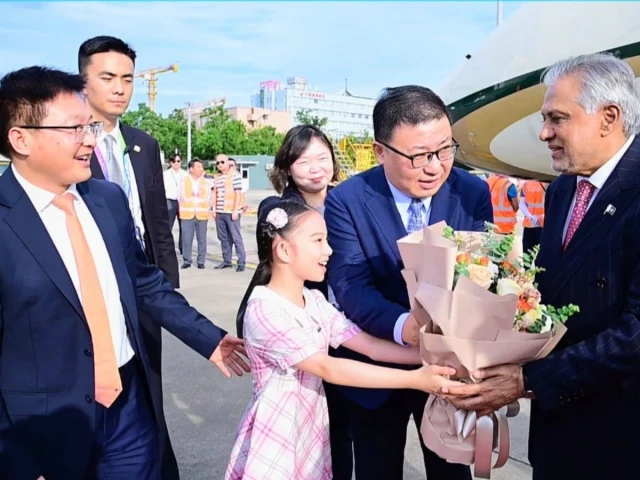
ISLAMABAD: Deputy Prime Minister and Foreign Minister Ishaq Dar on Thursday arrived in Shanghai on a two-day visit to attend the 2026 World Artificial Intelligence Conference and formalise the country’s participation in a new international artificial intelligence organisation, according to a statement issued by the Foreign Office (FO).
In a post on X, the Foreign Office said that upon his arrival in Shanghai, Dar was received by Standing Committee of the Municipal Party Committee Member Wu Wei and Vice Mayor of Shanghai, Pakistan’s Chargé d’Affaires to China Aizaz Khan, and Pakistan’s Consul General in Shanghai Shahzad Ahmad Khan.
Dar will also attend the opening ceremony of the 2026 WAICO on July 17 and hold bilateral meetings with his counterparts on the sidelines of the event, the Foreign Office said.
Earlier today, the FO said that the deputy prime minister had departed for Shanghai.
An earlier Foreign Office statement said Dar would also hold a bilateral meeting with Chinese Foreign Minister Wang Yi on the sidelines of the conference, alongside meetings with other counterparts to discuss matters of mutual interest.
It said he would present Pakistan’s perspective on strengthening international cooperation in artificial intelligence, with a focus on “inclusive, equitable” AI governance, capacity-building, and the priorities of developing countries, particularly those in the Global South.
During Prime Minister Shehbaz Sharif’s visit to China in May, the prime minister expressed support for China’s initiative of establishing the World Artificial Intelligence Cooperation Organisation, saying it “represents a concrete step toward promoting the development of artificial intelligence for good and for all,” and said it will work with China to “advance global governance and international cooperation on artificial intelligence.”
Pakistan has in recent years sought to position itself as an emerging player in the AI landscape, with growing talent pools and startups contributing to innovation in sectors such as healthcare, education, and agriculture.
The country approved its National Artificial Intelligence Policy last year, outlining a roadmap centred on innovation, public awareness, secure systems, and global collaboration. The plan includes an estimated Rs278 billion ($1 billion) investment by 2030, alongside initiatives such as the “AI Seekho 2026” programme aimed at training one million individuals.
Authorities have also launched a sovereign AI cloud and a startup fund to support the ecosystem, while working on a regulatory framework to promote ethical and responsible use of AI technologies.
The WAIC, scheduled from July 17 to 20 in Shanghai, is being held under the theme “AI Partnership for a Brighter Future” and is expected to draw global technology leaders, policymakers and researchers.
Chinese President Xi Jinping is set to attend the opening ceremony and deliver a keynote address, highlighting Beijing’s emphasis on AI as both a driver of economic growth and a cornerstone of global governance.
Organisers say the four-day event will feature over 140 forums and bring together more than 1,400 participants. An exhibition spanning over 100,000 square metres will showcase cutting-edge innovations, with more than 1,100 companies presenting over 3,000 exhibits, including hundreds of global debuts.
The conference has emerged as one of the world’s most influential AI platforms, offering a forum for discussions on technological breakthroughs, governance frameworks, and industry collaboration.
In addition to formal sessions, this year’s edition will extend into public spaces across Shanghai, incorporating AI-driven experiences into urban life while promoting innovation, talent exchange, and startup development.
Huawei’s Atlas 950 SuperPoD large-scale AI computing system will make its public debut during the July 17 to 20 forum in Shanghai. The launch is one of the clearest demonstrations yet of China’s efforts to assemble such systems without US giant Nvidia’s most advanced chips.
Designed for large-scale AI training and inference, the system links thousands of Huawei’s Ascend AI processors through high-speed interconnects so they operate as a single computing cluster.
DeepSeek’s latest V4 model has been adapted to run entirely on clusters built using Huawei’s Ascend chips, highlighting progress by Chinese firms in building AI ecosystems independent of US technology. Domestic media reported that Chinese chipmakers, including Biren and MetaX would also release new “supernode” computing clusters.
The gathering comes as Washington and Beijing prepare for their first government-level AI talks under US President Donald Trump’s administration, turning WAIC from a technology showcase into an early test of how China intends to compete for influence over the rules governing AI worldwide.
The two rivals set out competing visions for AI governance at a UN AI dialogue last week, where Washington argued that sweeping regulation would stifle tech breakthroughs and Beijing framed its low-cost, open-source AI models as a public good that would bridge global AI inequality.
“Against this backdrop, WAIC has become more than a technology showcase; it is now a geopolitical stage where Beijing seeks to articulate its vision of AI as both a national priority and a diplomatic instrument,” wrote George Chen, chair of digital practice at the Asia Group.
Nine Turing Award and Nobel laureates, including deep learning pioneers Yoshua Bengio and Richard Sutton, will also attend, but there is little representation from major US tech firms.
“China has been making inroads with Southeast Asian countries in terms of AI capacity-building, and portrays itself as speaking up for developing countries who are being left behind in the AI race,” an Asian diplomat told Reuters on condition of anonymity.
Other product launches expected at the forum include AI agent smartphones from ZTE-owned Nubia and AI startup StepFun, according to Chinese media.

