

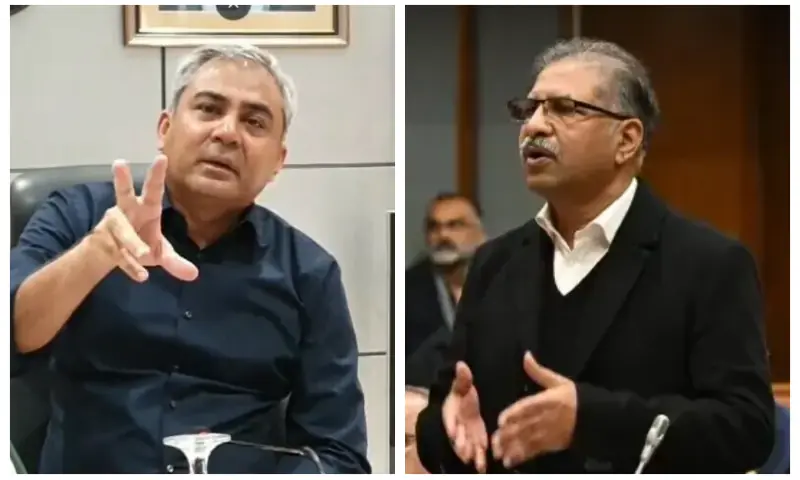
ISLAMABAD: Treasury and opposition members in the Senate debated the governor’s rule in Khyber Pakhtunkhwa on Tuesday, with PTI’s Barrister Ali Zafar terming the development a “political crisis disguised as a security solution” while federal ministers defended the move.
The Centre on Sunday imposed governor’s rule in KP and emergency in 12 of its districts, citing the PTI-led provincial government’s “deliberate disengagement” from the fight against terrorism. The proclamations now require Parliament’s approval.
It was against this backdrop that National Assembly and Senate sessions were convened on Tuesday.
In the Senate, PTI’s Parliamentary Leader in the Senate Barrister Ali Zafar remarked that what was happening in KP was not merely an administrative decision but a “test of Pakistan’s Constitution”.
“The Constitution must be our shield in a crisis, not a casualty of the crisis. The question is: are we using the Constitution to protect Pakistan, or are we using an emergency to change the political order of Pakistan?” he said.
Zafar said no political party or patriotic Pakistani wanted terrorism to flourish and that terrorism must be defeated with full strength. “But we must defeat terrorism without allowing the fight against terrorism to become a fight against constitutional democracy,” he said.
Referring to the constitutional provisions related to governor’s rule and emergency, he said Article 232 was to be employed in the situation of emergency and not as a “political weapon”.
Similarly, Article 234 provided for extraordinary arrangements intended for extraordinary circumstances, he added.
“Their existence does not mean they could be exercised without limits. The government must demonstrate that the constitutional conditions [for emergency and governor’s rule] have genuinely been met, that the action is necessary and proportionate, and that every applicable procedure has been followed. The existence of an emergency power does not place its exercise above the Constitution,” he said.
Zafar further argued that the Centre could not simply declare that a provincial government could no longer function constitutionally and treat that declaration as the end argument. The legal basis, evidence, scope and consequences must withstand scrutiny, and courts must remain free to determine legality, he asserted.
“If the government’s case is that terrorism has created an extraordinary situation in particular districts, it must explain why its response extended to the entire province and what safeguards protected the rest,” he added.
The PTI alleged that “this is a political crisis disguised as a security solution”, pointing to the timing of the measure that came amid heightened political tensions and a breakdown of the dialogue between the government and the opposition, including the PTI, in the Centre.
“You cannot restore public confidence by making people believe that their elected mandate can be taken away in the name of security,” he said.
Zafar said the issue concerned provincial autonomy, federalism, elected representation, fundamental rights and the balance between the federation and its units.
“Once extraordinary powers are normalised against one political opponent, no province and no party can assume it will never be the next one. Today it may be KP; tomorrow the precedent may be used elsewhere,” he warned.
Calling on the Senate not to become a “rubber stamp”, he said Parliament, which represented the federation and gave every province an equal voice, must examine legal grounds, demand evidence and scrutinise necessity and proportionality for the measures in KP.
“You may control the administration, but you cannot command democratic legitimacy. You may suspend a government, issue notifications and deploy the machinery of the state, but you cannot manufacture public trust by force.
“If emergency is genuinely about protecting citizens, prove it through lawful, targeted and accountable action. If it becomes an instrument to suppress an elected mandate, the damage will outlast this government,” he said.
Zafar added, “The Constitution is not an obstacle to national security; it is the foundation of national security. Break that foundation in the name of protecting Pakistan, and you may win control for a day but you will weaken the state for years to come.”
Leader of the Opposition in Senate Raja Nasir Abbas termed Oct 11, when emergency and governor’s rule was imposed in KP, a “black day”, ruing celebrations by the “champions of democracy over the removal of a democratic government elected with two-thirds majority”.
He maintained that an agreement between the Centre and the opposition had been reached on political issues, claiming that differences arose over linking security issues with political issues.
He warned that “unnecessary violence” created hatred against the state among youth and urged the immediate withdrawal of the imposition of governor’s rule and emergency, as well as the resolution of issues through dialogue.
Political matters could have been resolved by giving more time to negotiations, he added.
Ministers defend governor’s rule
For his part, Interior Minister Mohsin Naqvi maintained that imposition of governor’s rule and emergency in KP was not in violation of the Constitution.
“The PML-N and PPP sat together and examined every clause to ensure that no provision was violated,” he said, adding that the decision was not an easy one.
He said talks between the Centre and the opposition had focused on terrorism from the first day.
The minister added that the Centre had contacted the PTI leadership, including party Chairman Barrister Gohar Khan, on Oct 10, asking him to suggest amendments in the draft that was to be signed between the two sides after the talks. “Had an agreement been reached, this step would not have been taken,” he said.
Naqvi said the government made six amendments in the draft, which was sent to KP Chief Minister Sohail Afridi, who has become non-functional as the provincial chief executive following the imposition of governor’s rule. The interior minister alleged that Afridi forwarded the draft to PTI leader Murad Saeed, after which the matter was “sabotaged”.
Referring to security situation in KP, he said law enforcement and security personnel were laying down their lives while the “chief minister was delivering speeches against them”. He alleged that some in the PTI were in “contact with the Taliban and the Tehreek-i-Taliban Pakistan”, adding that evidence of this would be presented when required.
Deputy Prime Minister and Foreign Minister Ishaq Dar also spoke in the House, saying that the federal cabinet had “rightly decided” last week to end the process of political reconciliation with the PTI.
He stressed that the PPP and PML-N had both made efforts to reach a point of understanding with the PTI.
Regarding arguments that terrorism was also prevalent in Balochistan while emergency and governor’s rule were only in KP, he highlighted that the Balochistan government was “fully on board” with the Centre in fighting terrorism.
“Whatever has happened is according to the law and Constitution,” he contented.

