

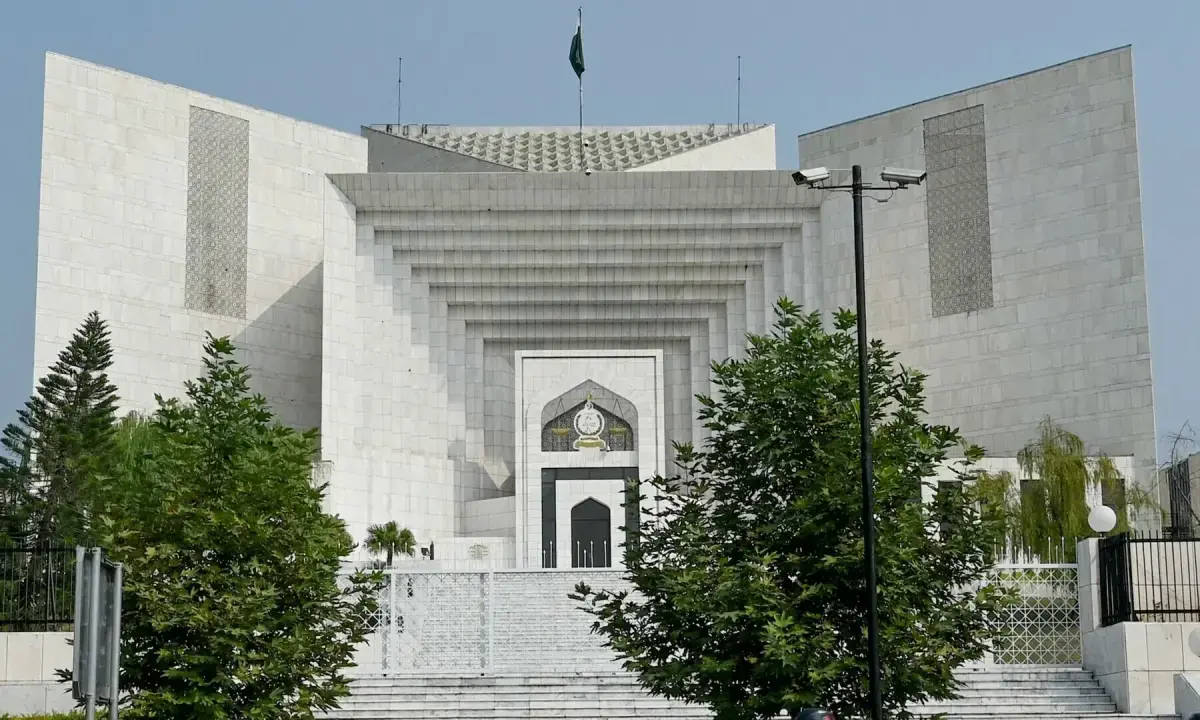
ISLAMABAD: The Supreme Court has regretted that litigants and their counsel sometimes treat the court’s benevolence and leniency as a mere procedural formality, disregarding the solemnity of its categorical directives.
“It is agonising to observe that litigants and their counsel frequently treat the benevolence of this court as a mere procedural formality, ignoring the solemnity of categorical directives,” Justice Salahuddin Panhwar observed in a three-page order, dismissing three civil miscellaneous applications seeking the restoration of review petitions.
Justice Panhwar was part of a three-member SC bench, headed by Justice Munib Akhtar and also comprising Justice Malik Shahzad Ahmad Khan.
The bench had taken up miscellaneous applications under Order XV Rule 5 read with Order XXXIII Rule 6 of the Supreme Court Rules, 1980, seeking recall of its Sept 12, 2024 order dismissing civil review petitions for non-prosecution.
“The bedrock of the judicial system is rooted in certainty, discipline and the profound sanctity of the orders passed by the Supreme Court,” Justice Panhwar emphasised.
The order noted that on March 4, 2024, the SC had accommodated counsel for the review petitioners by granting an adjournment on medical grounds.
However, the leniency was strictly circumscribed by a categorical and conditional direction that if the counsel was unable to attend on the next date, “for any reason whatsoever”, an alternative arrangement must be made, failing which the matter could be dismissed for non-prosecution.
Despite this unambiguous direction, when the matters were taken up on Sept 12, 2024, the mandate of the SC was “blatantly bypassed” and another adjournment was sought, the order said.
In one application, the counsel cited a stomach ailment caused by food poisoning, while in the others he cited pharyngitis, or inflammation of the throat.
He claimed that a slow nerve response and sedating medication had prevented him from making alternative arrangements.
The SC observed that it was a well-settled proposition of law that a conditional order created an absolute obligation.
Once a condition was inextricably linked to the grant of an adjournment, failure to fulfil it automatically triggered the stipulated consequence.
The bench had rightly observed on Sept 12, 2024, that the ailment mentioned in the medical certificate did not appear to be serious. More importantly, no alternative arrangement had been made, rendering the breach of the conditional order “categorical and absolute”, the order said.
The SC also noted that respondent No. 1, Mst Zaitoon, an elderly woman, had appeared in person to defend her rights, demonstrating greater diligence than the petitioners, despite the latter having been directed to make alternative arrangements.
“Conditionally passed orders are not just statements; they allow courts to balance fairness and compassion with the requirements of justice,” Justice Panhwar emphasised.
Allowing the applications to recall the Sept 12, 2024 order would render the March 4, 2024 conditional order “utterly redundant”, the SC held while dismissing the applications.

