

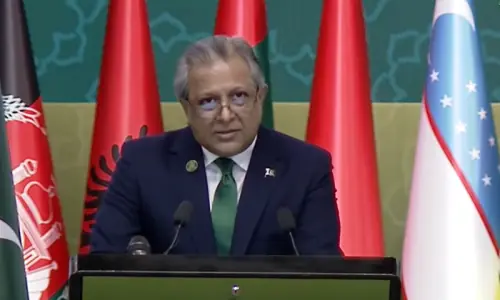
ISLAMABAD: Law and Human Rights Minister Azam Nazeer Tarar on Monday stressed that the “active engagement” of men was needed to promote equality as he addressed a conference on women’s empowerment in Islamabad.
Tarar was speaking on the second and final day of the Organisation of Islamic Cooperation’s (OIC) 9th Ministerial Conference on Women, which Pakistan is hosting. Delegates from 57 OIC member states gathered on Sunday to hold technical-level meetings.
Addressing the moot as the chair on Monday, Tarar affirmed that Pakistan continued to strengthen its legal policy and institutional framework to “advance the rights, opportunities and leadership of women”.
“Lasting progress cannot be achieved by women alone; real and sustainable change requires the active engagement of men and boys as partners in promoting equality, respect and shared responsibility,” he said.
The minister stressed that building inclusive societies was a “collective endeavour that demands the commitment of every institution and every citizen”.
“For Pakistan, empowerment of women is not simply a policy objective; it is a national priority enshrined in our Constitution, inspired by our faith and essential to our future,” he said.
Tarar said Pakistan was “expanding women’s leadership, promoting financial inclusion and entrepreneurship, bridging the digital divide, strengthening access to justice, and creating safe, more inclusive workplaces” through the National Gender Policy Framework, Vision 2025 and the Prime Minister’s Women Empowerment Package.
Speaking about Pakistan’s role as the chair for the OIC conference, he said Islamabad does not regard it as a position of prestige but rather as a “responsibility to listen carefully, build consensus and help transform our shared aspirations into practical action that improves the lives of women across the Islamic world”.
He observed that the true success of the conference would not be measured by the declarations adopted but by the “opportunities we create after we return home”.
The minister noted that women across the OIC countries were transforming economies, advancing scientific progress, strengthening institutions, leading businesses, serving in public offices and contributing to peace and humanitarian efforts.
“Their achievements continue to shape stronger families, more resilient communities and more prosperous nations,” he said.
“Yet, we also recognise that millions of women and girls continue to face barriers that restrict their opportunities and limit their ability to contribute fully to national development,” Tarar added.
He emphasised, “Our responsibility is not simply to acknowledge these realities. It is to change them.”
He further said that no nation could “fully realise its potential while half of its population is denied equal opportunity to learn, work, innovate and lead”.
“Our responsibility is not to define their potential. It is to remove the barriers that prevent it from being realised,” the rights minister said.
On collaboration among OIC states, Tarar said the countries could accelerate their progress by learning from one another, sharing successful experiences and strengthening institutional partnerships.
“The OIC provides a unique platform to translate these aspirations into collective action,” he remarked. In his address, the minister also mentioned women and girls living through conflict, occupation, displacement and humanitarian crises.
He particularly hailed the “resilience and courage” shown by women and girls in the occupied Palestinian territories and Gaza, along with remembering those in Afghanistan and India-occupied Kashmir.
“Their struggle reminds us that empowerment is not only about opportunities. It is equally about protection, dignity and hope. Our collective responsibility is to ensure that no woman or girl is left behind because of conflict, poverty and inequality.”
Tarar also underscored the importance of utilising digital innovations and artificial intelligence (AI) to expand access to education, healthcare, entrepreneurship and financial inclusion.
“If ignored, they risk creating new forms of inequality, discrimination and exclusion,” he warned. The minister stressed that the digital future must be a bridge to inclusion, and not a barrier for women.
‘Women do not have to beg for space’: Punjab CM
Punjab Chief Minister Maryam Nawaz also addressed the moot, highlighting the government’s initiatives to uplift and empower women. In particular, she pointed out that in many of these initiatives, opportunities for women were not capped by quotas, numbers or statistics.
“Talent does not recognise limits and neither should opportunity,” she said, highlighting that 60 per cent of young girls were beneficiaries of her scholarship and laptop schemes.
“When barriers are removed and opportunities are equal, women do not have to beg for space — they earn it,” the chief minister said.
She added that women must shape development rather than simply benefitting from it, stating that this principle guided her work: “This is why, across all programmes and across all policies, we have ensured that women are represented as participants, as beneficiaries, as entrepreneurs, as professionals, and leaders alongside men as equal partners.”
Maryam also drew attention to the Punjab government’s Apni Chhat Apna Ghar housing programme and the Apna Khet Apna Rozgar programme facilitating ownership of farmland. She said that close to 200,000 families representing nearly a million people had benefitted from the former programme, moving from the insecurity of rented homes towards “the dignity and permanence of a roof of their own”.
Among other initiatives, she also highlighted the Honhaar Scholarship Programme, which covered tuition expenses to allow young women to pursue further education, and her laptop scheme, terming a laptop “not just a learning tool — it is a classroom without walls; it is a library without limits; it is a passport to a digital economy.”
Federal Minister for IT and Telecom Shaza Fatima Khawaja, in her address, termed the forum’s theme of women’s socio-economic and political empowerment “central to our collective future”.
“When women fully enter the workforce, they unlock under-utilised talent pools, creating massive ripple effects that improve living standards for entire communities,” she said.
Alongside education and legal reform, the minister emphasised the importance of digital public infrastructure as it “dramatically” lowered the cost of women’s digital inclusion, lending them mobility by allowing them to apply remotely for education, healthcare, social protection, licences and government documentation.
She said that she saw technology as “an enabling infrastructure to empower women”, noting: “a connected device can bring a classroom to a girl whose school is far away; a secure digital account can place income directly under a woman’s control; a secure and online marketplace can allow a home based entrepreneur to sell beyond her city, her street and beyond her country; digital public reforms can bring women’s evidence and experience into government decisions.”
However, she highlighted that “technology can be a double edged sword; it can be used potentially to exclude” women who do not own phones, cannot afford data, lack digital identification, fear online harassment or have not learned how to safely use digital platforms.
Highlighting the strong women of Pakistan’s history, she said, “Our responsibility is to ensure that they become the norm and not the exception.”
‘No nation can grow while excluding half its population’
Also addressing the OIC conference, Senate Chairman Yousaf Raza Gilani paid tribute to former prime minister Benazir Bhutto, who served as the first woman prime minister of the Muslim world, adding that Muslim women today were continuing her legacy.
He also commended Nobel laureate Malala Yousafzai as an example for women’s empowerment.
Stressing the need to include women in the workforce, Gilani said, “No nation can achieve sustainable development while excluding half of its human capital from opportunity, leadership and decision-making.”
He further expressed Pakistan’s commitment to improving women’s empowerment through education, digital inclusion and employment opportunities.
Speaking on the initiatives undertaken by the government, he recognised the Benazir Income Support Programme for reducing poverty among vulnerable households and improving enrolment of girls and women in schools and educational institutions. He said that these initiatives had allowed women to participate in economic growth.
Gilani further added that Pakistan had taken steps to enhance women’s representation in elected bodies through reserved seats, allowing them to serve as parliamentarians, judges, diplomats, entrepreneurs, civil servants, journalists and industry leaders across various sectors.
In his speech, the Senate chairman also recognised the issue of gender-based violence, which he said continued to be one of the biggest barriers to women’s empowerment.
“Empowerment cannot flourish where violence and discrimination can increasingly persist,” Gilani said.

