

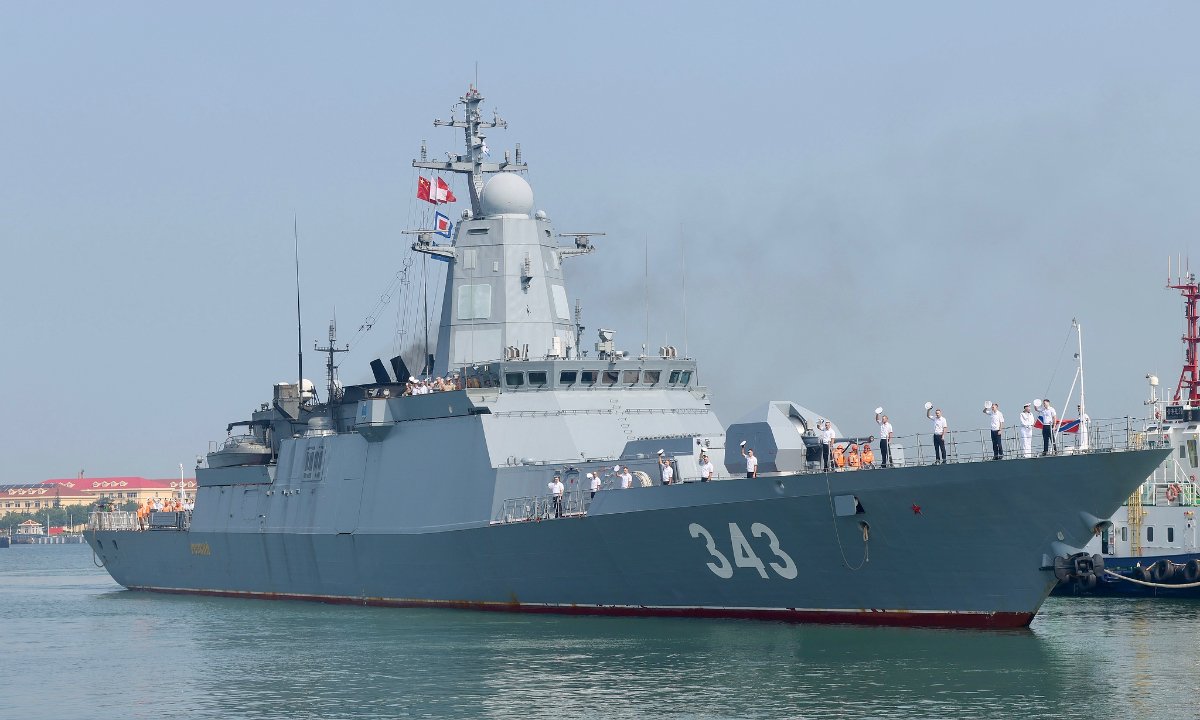
BEIJING: Chinese and Russian navies will hold the “Joint Sea-2026” naval exercise in July in waters and airspace near the port city of Qingdao, East China’s Shandong Province, China’s Ministry of National Defense announced Sunday.
Following the exercise, some forces from both sides will conduct a joint maritime patrol in relevant areas of the Pacific Ocean, the ministry said in a statement.
The ministry said the drill is part of the annual cooperation plan between the two militaries in responding to security challenges and safeguarding regional peace and stability.
With the arrival of the Russian vessels, all participating forces from both sides have assembled for the joint exercise in Qingdao. The Chinese side held a welcome ceremony for the Russian task force at the port.
At around 10 am on Sunday, after the Russian Navy’s guided-missile cruiser Varyag completed berthing, the commander of the Russian task force and the commanding officers of the participating vessels disembarked.
The Russian contingent includes the guided-missile cruiser Varyag, the frigate Rezkiy, the large submarine Ufa, and the rescue vessel Igor Belousov. The Chinese side has deployed the guided-missile destroyers Kaifeng and Anshan, the guided-missile frigate Wuhu, the comprehensive supply ship Kekexilihu, the submarine rescue ship Yangchenghu, and one submarine.
Both sides have assigned shipborne helicopters and marine personnel to participate in the exercise.
The exercise, themed “joint response to maritime security threats,” will be conducted in three phases: force assembly, port planning and coordination, and at-sea operations. It aims to demonstrate the two navies’ capability and determination to jointly address maritime security challenges, safeguard regional and international peace and stability, and further deepen the China-Russia comprehensive strategic partnership of coordination for a new era.
During the port phase, the two sides will hold courtesy meetings, conduct joint operational planning, and engage in professional seminars and exchanges. Participating officers and sailors will also tour each other’s vessels and take part in activities including a friendly basketball match and a reception. At sea, the exercise will feature a range of training scenarios, including joint reconnaissance, air and missile defense, and maritime strike operations.
China-Russia naval and air joint exercises, along with coordinated patrols, have increasingly become routine and are now conducted on an annual rotating basis, Song Zhongping, a Chinese military affairs expert, told the Global Times.
Song said that during this exercise, China deployed advanced frontline surface combatants, including guided-missile destroyers Kaifeng and Anshan, the guided-missile frigate Wuhu, reflecting a high level of participation, and on the Russian side, major surface combat assets such as the cruiser Varyag were sent to take part in the drills.
Both sides committed core operational naval forces to the exercise, underscoring the scale of the operation and its elevated level of realism and combat-oriented training, Song noted.
In August last year, the Chinese and Russian naval taskforces concluded the maritime drill phase of China-Russia Exercise Joint Sea 2025 at a sea area off Vladivostok in Russia.
The drill included joint maneuvers, joint submarine rescue, joint air defense, joint anti-ship operations, anchorage defense, replenishment at sea, and other subjects. Practical weapon operations were also organized, according to China Military Online.
One of the stated aims of the exercise is to reduce perceived threats to key maritime strategic corridors posed by certain regional countries. Through joint exercises, the two sides seek to demonstrate their ability to keep these sea lanes open and operate farther into the Pacific, said Song.
The drills are also presented as a signal of closer China-Russia coordination in responding to regional actors viewed as unfriendly, Song said, noting that the exercise serves not only to safeguard peace and stability in the region, but also to uphold the post-World War II international order.
Thus, the joint operation is intended to deter unilateral actions by certain countries, resist historical revisionism, and discourage behavior seen as undermining the security and well-being of neighboring countries, Song noted.

