Home Blog Page 16

Senate resolution lauds armed forces

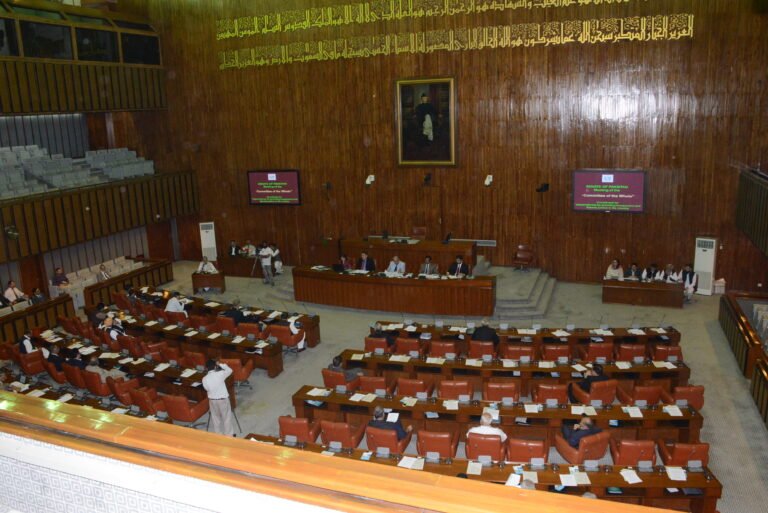
ISLAMABAD: The Senate on Thursday unanimously passed a resolution paying tribute to the armed forces, security institutions and the entire Pakistani nation for their sacrifices, courage and resolve in safeguarding the country’s sovereignty, security and national dignity.

The resolution was moved by Minister for Parliamentary Affairs Dr Tariq Fazal Chaudhry in the House.

The House paid tribute to the professionalism, timely strategy and bravery of the armed forces during “Marka-e-Haq” and “Operation Bunyan-un-Marsoos,” through which India’s “Operation Sindoor” was effectively foiled.

The operation had sent a clear message to the enemy that Pakistan possessed full capability to defend its sovereignty, national interests and territorial integrity.

It also appreciated the prudent leadership of President Asif Ali Zardari and Prime Minister Shehbaz Sharif for promoting national unity and effectively presenting Pakistan’s stance at the international level.

The House particularly paid tribute to Chief of Army Staff and Chief of Defence Forces Field Marshal Syed Asim Munir for his courageous leadership, military strategy and exceptional services towards national defence, stating that his leadership had further strengthened the morale and professional capabilities of the armed forces.

The resolution further honoured the martyrs and veterans of the armed forces who sacrificed their lives for the defence of the motherland, while also expressing solidarity with civilian victims and their families affected by enemy aggression and acts of terrorism.

It reaffirmed that the entire Pakistani nation stood shoulder to shoulder with its armed forces and that no compromise would be made on Pakistan’s defence, sovereignty and stability.

The House also appreciated the role played by political parties and the media during the situation.

Dar seeks Singapore’s help to repatriate 11 Pakistanis held on US-seized vessels

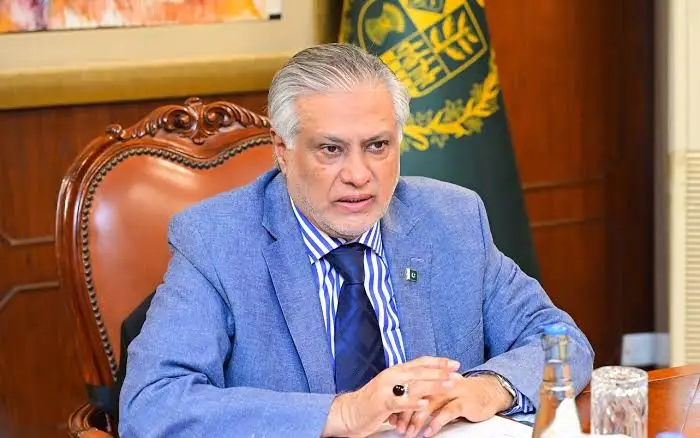
ISLAMABAD: Deputy Prime Minister and Foreign Minister Ishaq Dar on Friday said he has requested Singapore’s assistance in facilitating the welfare and repatriation of detained seafarers.

In a post on X, Dar said he spoke with Singapore’s Foreign Minister Vivian Balakrishnan regarding 11 Pakistani and 20 Iranian seafarers aboard vessels seized by US authorities and currently near Singaporean waters.

“I requested Singapore’s support in facilitating the welfare and repatriation of 11 Pakistani and 20 Iranian seafarers,” he said.

Dar also said he had spoken with Iranian Foreign Minister Abbas Araghchi, adding that Pakistan remains in close coordination with Iran on the matter. “Pakistan also stands ready to facilitate the safe repatriation of Iranian nationals to Iran via Pakistan,” he added.

He expressed appreciation for Singapore’s cooperation and support, saying the Foreign Office and relevant authorities are coordinating with US officials and others to ensure the safety, welfare, and early return of the nationals involved.

On Monday, Pakistan facilitated the transfer of 22 Iranian crew members held aboard the container ship MV Touska, seized by the US. In a statement posted on X on Monday, the ministry said the individuals were flown to Pakistan “last night and will be handed over to Iranian authorities today.”

“As a confidence-building measure by the United States of America, twenty-two crew members held aboard the seized Iranian container ship, ‘MV Touska’, have been evacuated to Pakistan,” it added.

“The Iranian ship will also be back-loaded to Pakistani territorial waters for return to its original owners after necessary repairs,” the statement added. MOFA said these returns were coordinated in tandem with support from both the Iranian and US sides.

On February 28, the US and Israel launched a joint offensive on Iran, and Tehran retaliated with strikes on Israel and other regional countries hosting US assets.

The war has been on hold since April 8, when Pakistan mediated a two-week ceasefire. Following the ceasefire, Pakistan hosted the highest-level US-Iran talks since the 1979 Islamic Revolution, which ended in Islamabad last weekend without agreement, but the ceasefire was held.

Despite the ceasefire, the US started intercepting Iranian ships.

Iran later blocked nearly all ships passing through the Strait of Hormuz apart from its own as Trump imposed a separate blockade of Iranian ports. The closure of the Strait, a chokepoint for about 20% of global oil and liquefied natural gas shipments, resulted in a phenomenal rise in global oil prices.

On Sunday, President Donald Trump said the US would start helping to free ships stranded in the Gulf. Trump gave few details of the plan to aid ships and their crews that have been “locked up” in the vital waterway and are running low on food and other supplies for more than two months.

The unified command of Iran’s armed forces responded by warning US forces to stay out of the strait. It said the Iranian forces would “respond harshly” to any threat, asking commercial ships and oil tankers to refrain from any movement without coordination with Iran’s military.

On Tuesday, President Trump announced he would briefly pause an operation to help escort ships through the Strait of Hormuz, citing “great progress” toward a comprehensive agreement with Iran as well as the “request of Pakistan and other Countries”.

Hours earlier, US Secretary of State Marco Rubio had ‌outlined the effort that began on Monday to escort stranded tankers out of the Gulf. The strait has been virtually shut since the conflict began, blocking some 20% of world oil supplies and igniting a global energy crisis.

“Based on the request of Pakistan and other countries, the tremendous Military Success that we have had during the campaign…Great Progress has been made toward a Complete and Final Agreement with Representatives of Iran.” He wrote on Truth Social.

Pakistan hopeful of early US-Iran deal to restore regional peace: FO

ISLAMABAD: Foreign Office Spokesperson Tahir Andrabi said on Thursday that Islamabad was optimistic about a peace agreement between the United States and Iran and expected a deal to be struck “soon” to bring peace to the region and the world, even though no timeline had been confirmed.

“We remain optimistic, and… expect an agreement sooner rather than later. We hope the parties will reach a peaceful and sustainable solution that brings peace not just to our region but to the world at large,” said Andrabi during a weekly press briefing in Islamabad.

He told reporters that Pakistan would welcome a settlement between Iran and the US wherever it may be reached. “If an agreement is reached in Pakistan, it would be an honour for us,” he said.

Andrabi didn’t go into the specifics behind those expectations, declining to confirm reports about a potential memorandum of understanding that US and Iranian officials are reportedly inching towards. He did not confirm the document’s length either.

The spokesperson reiterated that Prime Minister Shehbaz Sharif welcomed the “timely announcement” regarding the pause in “Project Freedom” on Wednesday in a post on X, noting that Pakistan remained committed to supporting all efforts that promote restraint and the peaceful resolution of conflict between the US and Iran through dialogue and diplomacy.

Andrabi added that “working with the same spirit of optimism and positive engagement”, Deputy Prime Minister and Foreign Minister Ishaq Dar worked with his counterparts throughout the last week in the pursuit of peace, diplomacy and a settlement between Washington and Tehran.

He said that, as CBM by the US, 22 crew members held from the seized Iranian container ship MV Touska were evacuated to Pakistan and later sent to Iran, which was coordinated with the support of both the Iranian and US sides.

Andrabi also highlighted a joint statement by the foreign ministers of Turkiye, Bangladesh, Brazil, Cambodia, Jordan, Libya, Malaysia, Spain, and South Africa regarding the Israeli assault on the Global Samud Flotilla.

On the first anniversary of Marka-e-Haq, reiterating Pakistan’s desire for dialogue and diplomacy, he made it clear that Pakistan would respond with full strength and all available means if aggression was imposed on it, as it was exactly one year ago.

“Pakistan’s position on every issue is firmly anchored in international law, the UN Charter, and relevant UN Security Council resolutions. We do not talk of war or clashes; we talk of dialogue and diplomacy. However, if aggression is imposed on us as it was exactly one year ago, Pakistan will respond with full strength and all means available,” Andrabi said.

He called the Operation Bunyanum-Marsoos a “defining moment” in the national journey, which was not just about remembering the past but about shaping the future.

“Because the spirit of Marka-e-Haq lives not just in our history, but in each of us,” he remarked.

Andrabi said that Pakistan had always understood the importance of diplomacy, dialogue, and the peaceful settlement of all bilateral issues with India.

“Pakistan has never shied away from dialogue with India on any issue. The fact that dialogue has not taken place cannot be blamed on Pakistan. We have repeatedly expressed our readiness for dialogue. However, it takes two to dialogue, and for it to be meaningful, it must be a dialogue and not a monologue. It is for everyone to judge who is responsible for the absence of dialogue.”

He said that Pakistan’s response under Operation Bunyanum Marsoos was measured, lawful, and in line with the UN Charter.

He said that FM Dar also briefed the Diplomatic Corps on the first anniversary of Marka-e-Haq, wherein he highlighted that the Jammu and Kashmir dispute remained central to regional stability and called for its resolution under the UN auspices through an impartially held plebiscite, besides cautioning against any unilateral action on the Indus Waters Treaty.

He said that peace and security in South Asia remained a concern for international partners, as the belligerent statements emanating from New Delhi were a cause of concern.

Spokesperson said that the first anniversary of Marka-e-Haq was an occasion to reinforce the national resolve that the sovereignty, territorial integrity, and political independence of the country would be defended with all means possible and with full resolve.

On the IWT, the spokesperson said that Pakistan would explore all legal and political mechanisms enshrined in the Treaty and under international law to secure its rights over the waters of the Indus Basin.

“All options remain on the table. Some are already underway through the Indus Waters Commissioners. We are closely monitoring the implementation of the Treaty and documenting all variations in river flows. All efforts are being made to ensure that not a single drop of water that is Pakistan’s right is taken away.”

Commenting on the Indian arms build-up and force modernisation, the spokesperson said that Pakistan was mindful of the impact of India’s force modernisation on strategic stability in South Asia.

“Our military preparedness and our own acquisitions of technologies would be sufficient to maintain our robust defence, robust military preparations and maintain our credible minimum deterrence vis-a-vis India.”

On Pak-Afghan relations, he welcomed the agreements among tribal elders in Bajaur and Chitral but reiterated that the single issue of terrorism emanating from Afghan soil was holding back the bilateral relations.

He said if the Taliban administration provides credible assurances that Afghan soil would not be used against Pakistan, all other issues between the two nations could be resolved easily.

Andrabi also told the media that 49 of 54 Pakistanis detained in Cambodia, following a raid on a scamming compound, had returned, and the remaining three would return soon.

Moreover, about 85 Pakistani nationals, detained in Kampala on April 27 for engaging in unauthorised employment while on visit visas, he said that Pakistan’s embassy there engaged with the relevant authorities and ensured their expeditious repatriation by Wednesday.

To another question about the MV Abdullah vessel hijacked by Somali pirates, also carrying 10 Pakistanis on board, he said the individuals had not yet been released as a direct contact was made on Wednesday with the Somali authorities, who assured us that they were negotiating with the pirates for the release of all individuals.

PM Shehbaz launches development projects in G-B, sets deadline for 100MW solar scheme

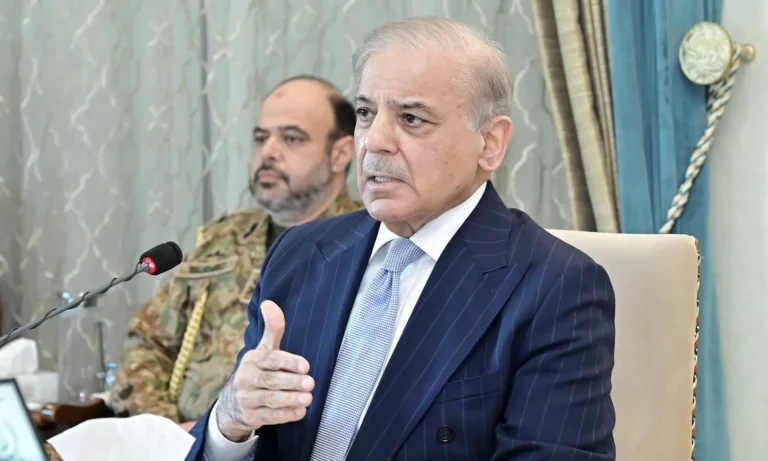
GILGIT: Prime Minister Shehbaz Sharif on Thursday directed that a 100-megawatt solar project be completed by mid next year while inaugurating and laying the foundation stones of several development projects in Gilgit, Radio Pakistan reported.

The prime minister arrived in G-B on a one-day official visit. Upon arrival in Gilgit, the prime minister was received by Governor Syed Mehdi Shah and caretaker Chief Minister Justice (retd) Yaar Muhammad.

Addressing a ceremony during the visit to the region, he expressed his firm commitment to its development and that of Azad Jammu and Kashmir.

The prime minister said all necessary resources would be provided to address the problems of G-B.

PM Shehbaz said that four Daanish schools were being established in the region that would provide free education, meals and uniforms, emphasising that these schools would feature smart boards and e-libraries.

The premier said that the laptops, business and agriculture loan cheques provided to the youth under the Prime Minister’s Youth Programme were given on merit.

He said the laptops were an acknowledgement of the youth’s hard work in the field of education.

Turning to the regional situation, PM Shehbaz said Pakistan played a pivotal role in brokering a ceasefire between the US and Iran, expressing the confidence that this role would be remembered in history. He was confident that the ceasefire would prove to be long-lasting and that there would be a durable peace in the region.

He was accompanied by a high-level delegation, including federal ministers Ahsan Iqbal, Awais Leghari, Attaullah Tarar, Engineer Amir Muqam, Abdul Aleem Khan, Dr Khalid Maqbool Siddiqui, Adviser to the Prime Minister Rana Sanaullah and Special Assistant Talha Burki.

During the visit, the prime minister held separate meetings with Governor Syed Mehdi Shah and caretaker Chief Minister Yaar Muhammad. The meetings focused on the progress of ongoing development projects in G-B, the law and order situation, and other regional administrative matters.

The visit was part of the federal government’s engagement with G-B on development planning and governance issues.

No one can harm Pakistan, ready to answer any aggression: DG ISPR on Marka-e-Haq anniversary

RAWALPINDI: Director General of Inter-Services Public Relations, Lt Gen Ahmed Sharif Chaudhry, on Thursday, said that “no one can harm Pakistan”, as we inflicted a crushing defeat on an enemy five times larger across all fronts, adding that the armed forces were ready to respond to any future aggression.

The term “Marka-e-Haq” refers to the 2025 conflict with India, which began with the April 22 Pahalgam attack and concluded with a ceasefire on May 10 following Operation Bunyanum Marsoos.

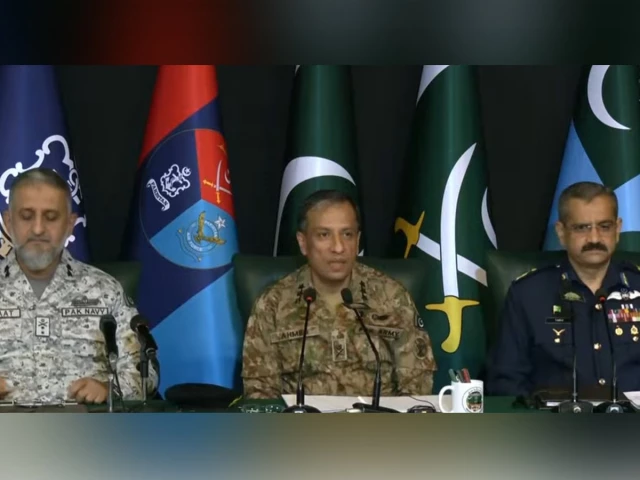
Addressing a press conference marking one year since the completion of Marka-e-Haq, accompanied by senior officers of the Pakistan Navy and Pakistan Air Force, he congratulated the nation on the occasion. He said Pakistan had inflicted a humiliating defeat on India across all fronts.

Lt Gen Chaudhry said, “A year ago, we ground India’s pride into the dust. We have always said that no one can harm Pakistan. We were ready then, and we are ready now; if anyone has any doubt, we have shown them one episode of it”.

“Pakistan defeated the enemy on every front and changed the nature of warfare during Marka-e-Haq, stating that Pakistan achieved success in multi-domain warfare across air, land, sea, and cyber domains,” he added.

DG ISPR said India had long propagated a false narrative accusing Pakistan of involvement in terrorism and had conducted false flag operations for this purpose, adding that allegations were levelled against Pakistan within minutes of the Pahalgam incident without investigation.

He further added that India’s “terrorism drama” has been buried forever, calling India itself the biggest terrorist. He challenged India to identify which terrorist camp it targeted, and said that India orchestrated terrorism against its own people to blame others.

The DG ISPR said India was facilitating terrorism and that all terrorist incidents in Pakistan involved India and Afghanistan. He added that Afghanistan’s “so-called” foreign minister sought assistance from India.

He also pointed out that India had failed to produce evidence regarding the Pahalgam incident. He noted that an FIR was registered within ten minutes of the event, yet a year later, no proof had surfaced.

Lt Gen Chaudhry said that what happened in Marka-e-Haq was known not just in Pakistan, but by every child in India and also advised India to speak the truth, adding that Hindutva ideology was being imposed on minorities in India.

Indian politicians appeared more like warriors than statesmen and said India’s professional military had been compromised by politics and India was using Fitna-al-Khawarij and Fitna-al-Hindustan out of frustration over its defeat, he said.

The term Fitna al-Khawarij is used by the state to refer to terrorists affiliated with the banned TTP.

He added that Pakistan was the principal contributor to regional stability and efforts for peace, stressing that war between two nuclear states would be madness.

DG ISPR announced that a “small glimpse” of Pakistan’s power potential would be shown to the public on August 14, so that “they cannot say later that they weren’t told.” He vowed to defend Pakistan’s security and sovereignty at all costs.

He also added that Kashmir was not India’s internal matter but a globally recognised dispute with pending UN resolutions, India was committing atrocities against Muslims in Kashmir and citizens in Manipur.

DG ISPR emphasised the significance of the mutual defence pact between Pakistan and Saudi Arabia, underscoring Pakistan’s pivotal role in guarding the two holiest sites in Islam.

In response to a question, he said that Pakistan was chosen to protect Harmain Shareefain (the Masjid al-Haram in Makkah and the Masjid-e-Nabawi in Madinah), and “protecting these sacred sites is intrinsically linked to Saudi Arabia’s national security.”

He further stressed that any threat to Saudi Arabia would be considered a direct threat to Pakistan.

Chaudhry described the defence pact as a “manifestation” of the longstanding ties between Pakistan and Saudi Arabia, which span several decades and cover multiple domains. “We will fulfil our duty and honour the commitments we have made,” he said.

In response to a question regarding the status of Operation Ghazab lil Haq in Afghanistan, he stated that the operation was still ongoing.

Chaudhry emphasised that Pakistan harbours no animosity towards Afghanistan or its people. “We have nothing against Afghanistan, especially the people of Afghanistan,” he said, underlining Pakistan’s longstanding position as a friend and host to Afghan refugees.

The military spokesperson further highlighted Pakistan’s role as “the best of brothers” and a host to Afghans, showcasing the nation’s commitment to brotherhood and hospitality. “There’s no better example of brotherhood and hospitality,” he added.

He explained that the operation was an integral part of Pakistan’s national response to terrorism.

Addressing the presser, Rear Admiral Shifaat Ali Khan described Marka-e-Haq as a “historic and memorable” event, where Pakistan’s naval forces delivered a decisive blow to India’s naval capabilities. Reflecting on the events leading up to the conflict, he noted that the Indian Navy had long prided itself on its military strength and dominance in the region.

However, he questioned why the Indian Navy failed to challenge Pakistan during the conflict. “The question remains as to why their naval force was unable to muster the courage against Pakistan,” he added.

He went on to reveal that India had tried to deploy its vessels in the northern Arabian Sea during the conflict, with the aim of targeting Pakistan’s naval assets and disrupting vital maritime trade routes. “The only purpose behind this move was to inflict economic harm on us by disrupting our naval trade and waterways,” he said.

The Rear Admiral Ali emphasised that the country’s waterways remained uninterrupted, and vital installations and ports stayed protected throughout the conflict.

He also highlighted the vigilance of the Pakistan Navy, stating that the force continued to monitor the enemy’s activities through its modern surveillance systems.

“The Pakistan Navy and Pakistan Air Force (PAF) were prepared to destroy the Indian aircraft carrier Vikrant,” he recalled. Despite the preparations, he pointed out, the Indian Navy remained confined to its sanctuaries, and the conflict ended without further escalation.

PAF achieved an 8-0 Outcome in its engagement with the IAF: Air Vice Marshal Ghazi

Air Vice Marshal (AVM) Tariq Ghazi, in a press briefing, highlighted key strikes against India’s air and military infrastructure. He described the operation as an “exceptionally synchronised” effort, where both defensive and offensive strategies by the PAF proved decisive.

Ghazi pointed out that the Indian Air Force’s (IAF) initial aggressive deployment, which included key assets and offensive weapon systems, was tracked meticulously by the PAF. He stressed that the results were decisive, with the PAF achieving an 8-0 outcome in its engagement with the IAF.

The senior PAF official elaborated on the success of the strikes, noting that Pakistan’s offensive reached devastating levels. He revealed that the PAF had destroyed four Rafales, a MiG-29, a Su-30, a Mirage 2000, and a multi-role unmanned aerial system.

He further elaborated that the PAF’s attack on India’s S-400 systems was carried out by JF-17 Block III aircraft, developed domestically in Pakistan.

Reflecting on the success of the operation, AVM Ghazi said that Marka-e-Haq had set a precedent for air warfare. “It’s the first time in history that full-spectrum, multi-spectrum operations were demonstrated,” he noted, calling it a “classical case study for air warfare experts.”

He added that the PAF’s response had been “overwhelming and shocking” to India, with the PAF demonstrating a formidable homegrown kill chain. Ghazi praised the PAF’s ability to integrate all operational elements into a single force, further solidifying its dominance in the conflict.

Looking ahead, Ghazi said the PAF was focused on enhancing its capabilities to maintain its qualitative edge in future conflicts.

PAF showed unmatched capability and dominance in Marka-e-Haq: air chief

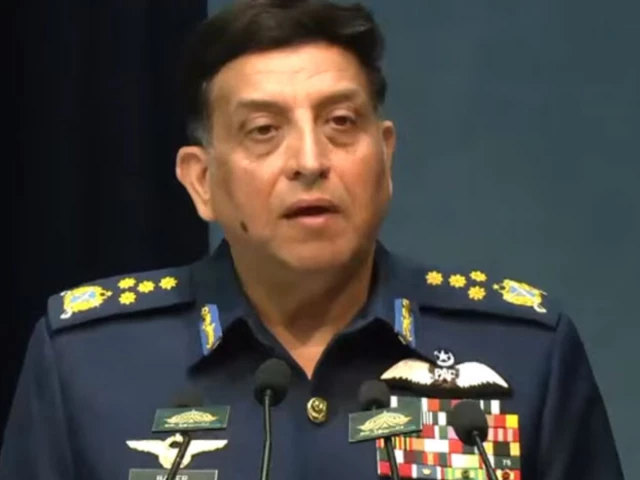
ISLAMABAD: Chief of Air Staff Air Chief Marshal Zaheer Ahmed Baber Sidhu on Thursday said that Pakistan Air Force (PAF) displayed its capability, resilience, and dominance in Marka-e-Haq, upholding the glorious legacy being second to none, Radio Pakistan reported.

The term “Marka-e-Haq” refers to the 2025 conflict with India, which began with the April 22 Pahalgam attack and concluded with a ceasefire on May 10 following Operation Bunyanum Marsoos.

Addressing a ceremony on the occasion of the completion of one year of Marka-e-Haq at Air Headquarters in Islamabad, the air chief marshal said Pakistan’s resounding success was the outcome of a unified approach by all elements of the national power and the blessings of God Almighty.

He mentioned that PAF conducted a full-spectrum multi-domain operation for the first time in the history of air warfare. He said the world was stunned to witness this superb execution of the PAF operation that was excellently choreographed and flawlessly executed, adding that the PAF attacked many high-value and high-visibility targets.

The air chief said that Pakistan’s cyber “Shaheens” have destroyed the enemy’s cyber security and, while delivering a humiliating defeat to the Indian Air Force (IAF), brought down some of the world’s top fighter jets, state broadcaster PTV reported.

He said we disrupted the enemy’s power and transport system, crippled its critical operational installations, shot down most modern Rafale jets, and destroyed a state-of-the-art S-400 battery. He said the enemy was literally on its knees long before we could imagine.

The air chief said that at the core of this success was Pakistan Air Force’s homegrown kill chain that seamlessly integrated all our operational elements into a single formidable force package. Sidhu said PAF could have gone further, but “we exercised responsibility and well-calibrated force application.”

Looking ahead, the air chief said we remain singularly focused on preparing hard for future challenges. He mentioned that a range of capabilities at the National Aerospace Science and Technology Park are expanding at an unprecedented pace. He said a host of indigenous projects are in the pipeline and they are vigorously being pursued.

He added that the exemplary leadership of the Chief of Army Staff and Chief of Defence Forces Field Marshal Syed Asim Munir played an important role in securing victory, and that the country’s leadership made it possible to achieve these successes.

He concluded that the PAF will always live up to the expectations of the brave and resilient people of Pakistan, assuring that the PAF will remain a symbol of pride for the nation.

China urges immediate ceasefire, prioritises talks on Iran situation: FM

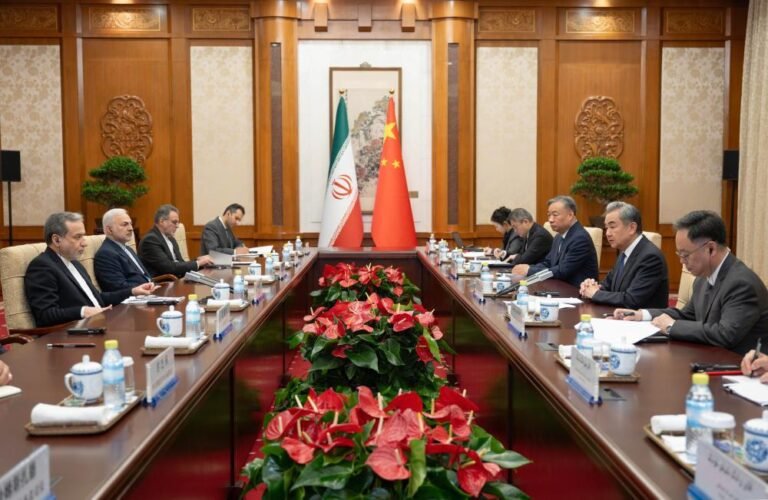
BEIJING: China calls for an immediate and full ceasefire, opposes renewed conflict, and stresses the priority of talks on the Iran situation, said Chinese Foreign Minister Wang Yi on Wednesday.

Wang, also a member of the Political Bureau of the Communist Party of China Central Committee, made the remarks during talks with Iranian Foreign Minister Seyyed Abbas Araghchi in Beijing. Noting the international community’s common concern over restoring normal and safe passage through the Strait of Hormuz, Wang urged relevant parties to respond to global calls as soon as possible.

The Iranian foreign minister briefed Wang on the latest developments in Iran-U.S. negotiations and Iran’s considerations for the next steps. He said that Iran will firmly safeguard national sovereignty and dignity, while continuing to build consensus through peaceful negotiations in pursuit of a comprehensive and permanent solution.

Araghchi stressed that at present, the issue regarding the opening of the Strait of Hormuz should be handled properly and resolved as soon as possible.

Iran highly appreciates and endorses China’s four-point proposal on promoting peace and stability in the Middle East, and commends China for its unremitting efforts to play a constructive role in preventing the situation from deteriorating and spilling over, Araghchi said.

He added that Iran places its trust in China and expects China to continue its active role in promoting peace and ending hostilities. Iran also supports the establishment of a new post-war regional architecture that can balance development and security, Araghchi said.

Noting the Iran-China comprehensive strategic partnership, Araghchi said Iran consistently adheres to the one-China principle and supports China in safeguarding its core interests. He also added that Iran is willing to strengthen communication and coordination with China in multilateral affairs and continuously deepen the partnership.

Wang emphasized that since the outbreak of the conflict, China has consistently and actively promoted peace talks.

He noted that the current situation has reached a critical juncture over whether the conflict can be brought to an end, expressing support for Iran in safeguarding its national sovereignty and security, and appreciation for Iran’s willingness to seek a political resolution through diplomatic channels.

Wang said China appreciates Iran’s commitment to not developing nuclear weapons, while also recognizing Iran’s legitimate right to the peaceful use of nuclear energy.

China encourages Iran and more Gulf nations to engage in dialogue and foster good-neighborly relations, and supports regional countries in building a peace and security architecture based on broad participation, safeguarding shared interests, and achieving common development, Wang said.

He added that China will remain committed to deescalating tensions and ending hostilities, and will continue to provide support for initiating peace talks, playing a greater role in restoring peace and tranquility in the Middle East.

On bilateral relations, Wang said China is a trusted strategic partner of Iran, adding that China is willing to work with Iran to consolidate and deepen political mutual trust, maintain and strengthen high-level exchanges, deepen mutually beneficial cooperation across various fields, and continue to advance the China-Iran comprehensive strategic partnership.

Imran, Bushra counsel seeks adjournment of May 7 hearing, cites no mandate to argue £190m appeals

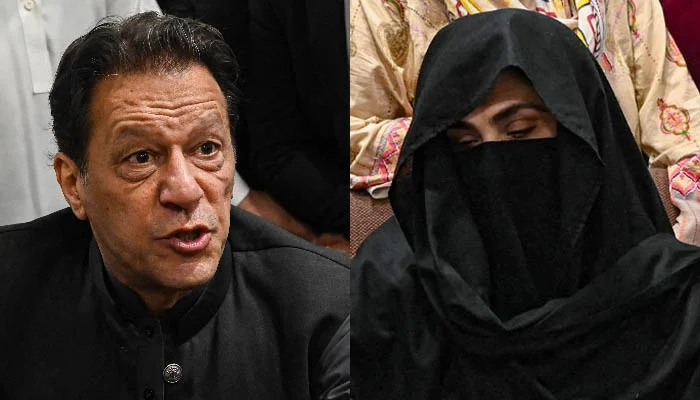
ISLAMABAD: A day before the scheduled hearing in the £190 million corruption case, counsel for former prime minister Imran Khan and his spouse Bushra Bibi on Wednesday said they were not authorised to argue the main appeals against conviction and sought an adjournment of the May 7 hearing.

In an application filed before the Islamabad High Court (IHC), Barrister Salman Safdar, PTI Secretary General Salman Akram Raja and Sarmad Muneeb said their engagement was limited to arguing applications for suspension of sentence, adding that no formal power of attorney or instructions had been obtained for the main appeals.

The lawyers also informed the court that, despite repeated efforts, the authorities at Adiala jail had not facilitated meetings with the clients for the purpose of obtaining instructions or executing fresh powers of attorney.

“The undersigned expresses inability to proceed further in the absence of proper instructions, formal engagement, and requisite Power(s) of Attorney,” the application stated.

The counsel prayed to the court to issue strict directions to the jail authorities to allow meetings with the clients and to adjourn the main appeals fixed for hearing on May 7.

The development comes after a two-member bench of the IHC, headed by Chief Justice Sardar Muhammad Sarfraz Dogar, on April 30 rejected the couple’s plea seeking the suspension of their sentence in the same case, observing that the main appeals were already fixed for hearing. The court had declared the suspension applications infructuous and directed arguments on the main appeals for May 7.

Imran Khan and Bushra Bibi were sentenced on January 17, 2025, by an accountability court to 14 and seven years respectively in the £190 million corruption case, also known as the Al-Qadir Trust case. Both have challenged their convictions before the IHC.

The case alleges that the couple obtained billions of rupees and land worth hundreds of kanals from Bahria Town Ltd to legalise Rs50 billion identified and returned to the country by the United Kingdom during the PTI government.

Pakistan pushes for lasting peace in US-Iran conflict: PM

ISLAMABAD: Prime Minister Shehbaz Sharif on Wednesday said Pakistan desires a permanent end to the US-Iran war for peace in the region, Radio Pakistan reported.

Addressing the sixth International Paigham-e-Islam Conference in Islamabad, he strongly highlighted Pakistan’s mediation efforts, saying these led to the opening of doors for negotiations between the two sides.

He expressed confidence that the dialogue will soon turn into sustainable peace in the region without further loss of human lives.

Terming Pakistan’s role as historic, the prime minister said history will always remember these efforts in golden words. He appreciated the efforts of the Chief of Army Staff and Chief of Defence Forces Field Marshal Syed Asim Munir for the ceasefire and talks between the two sides.

The prime minister paid tribute to Saudi Crown Prince Mohammed bin Salman for his role in peace talks. He said that China, Turkiye and other fraternal countries also contributed to this process.

PM Shehbaz said Pakistan pursued a balanced and principled stance in the current regional context.

He emphasised that Pakistan and Saudi Arabia have also opened a new chapter in their bilateral relations, adding that the protection, defence and security of Harmain Sharifain are dearer to Pakistan than our lives. He said the defence agreement between Pakistan and Saudi Arabia is a reaffirmation of this firm resolve.

PM Shehbaz said Pakistan stands firm on its principled position on Palestine and Jammu and Kashmir. He said Pakistan will continue to stand by the Palestinian and Kashmiri people until they achieve the right to self-determination.

The prime minister called upon religious scholars to further promote unity and harmony in the Ummah in the light of the teachings of the Holy Prophet Hazrat Muhammad (Peace Be Upon Him). He said those who stoke division in the Ummah and perpetrate terrorism cannot be called Muslims.

Addressing the second session of the conference, Deputy Prime Minister (DPM) Ishaq Dar underscored Pakistan’s commitment to regional peace and stability.

He highlighted sustained diplomatic engagement for de-escalation and dialogue in the region and beyond.

Dar reaffirmed Pakistan’s principled stance on Jammu and Kashmir and Palestine. He emphasised the importance of Muslim unity, the central role of the OIC, and collective action for the welfare of the Ummah. He also highlighted Pakistan’s leadership in combating Islamophobia globally and promoting interfaith harmony.

The deputy prime minister paid tribute to Pakistan’s resilience and national resolve, reflecting on the anniversary of “Marka-e-Haq”.

He emphasised that, under Prime Minister Shehbaz Sharif’s leadership, peace, progress and prosperity remain central to Pakistan’s national vision.

Dar welcomed and lauded the participation of distinguished international and national ulema and scholars, noting the importance and timeliness of the conference.

US President Donald Trump on Tuesday announced a pause in “Project Freedom”, an operation to escort ships through the Strait of Hormuz, citing “great progress” towards a comprehensive agreement with Iran, as well as requests from Pakistan and other countries.

On February 28, the US and Israel launched a joint offensive on Iran, and Tehran retaliated with strikes on Israel and other regional countries hosting US assets.

The war has been on hold since April 8, when Pakistan mediated a two-week ceasefire. Following the ceasefire, Pakistan hosted the highest-level US-Iran talks since the 1979 Islamic Revolution, which ended in Islamabad last weekend without agreement, but the ceasefire was held.

Khawaja Asif warns of stronger response to future aggression

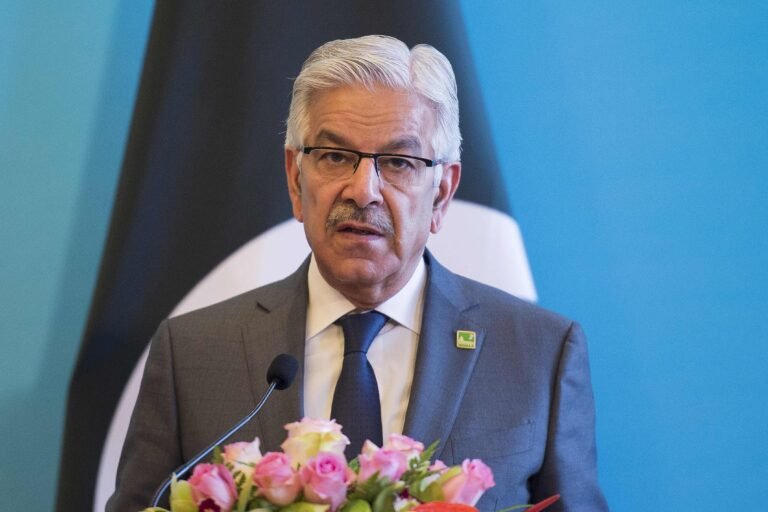
ISLAMABAD: Defence Minister Khawaja Asif on Wednesday said Marka-e-Haq has made it clear that any future aggression will be met with a response far more intense and decisive, Radio Pakistan reported.

On May 13, 2025, Prime Minister Shehbaz Sharif declared that May 10 will be observed annually as Youm-e-Marka-e-Haq to commemorate the “magnificent success” of ‘Operation Bunyanum Marsoos’ and to express national solidarity

In a video statement, the defence minister said the retaliatory capabilities of the Army, Navy, and Air Force are faster and more coordinated than the enemy can imagine.

He said the entire nation stands united with its armed forces as a steel wall.

Asif said the insight and confidence of Pakistani youth are the nation’s true strength and that they know how to defend the country.

On Tuesday, speaking at the launch ceremony of a picture book titled The Battle of Truth (Marka-e-Haq), published by the Ministry of Information and Broadcasting (MoIB) in collaboration with the Inter-Services Public Relations (ISPR), the minister said the entire nation stood united against any form of enemy aggression.

He said Pakistan had emerged as a more stable and powerful country and had become a symbol of stability in the region. “We are ready for any kind of Indian proxy war,” he added.

The minister said the Pakistan armed forces had foiled India’s “nefarious designs” during Marka-e-Haq and successfully neutralised its S-400 air defence system.

He said no country in the region was safe from India’s Hindutva mindset, adding that it had repeatedly imposed wars on Pakistan to divert attention from its internal issues.