Home Blog Page 22

Chinese envoy lauds Pakistan’s peace diplomacy in meeting with PM Shehbaz

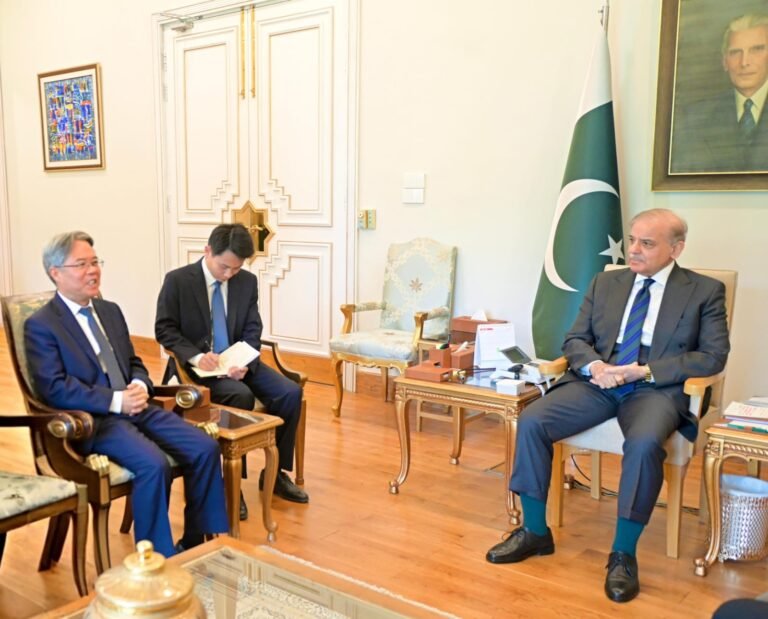
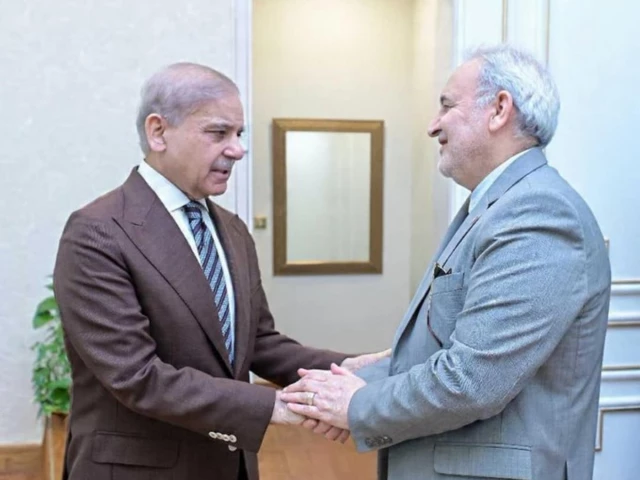
ISLAMABAD: Chinese Ambassador to Pakistan, Jiang Zaidong, on Thursday lauded Pakistan’s diplomatic efforts for peace in the Middle East during a meeting with Prime Minister Shehbaz Sharif, where both sides discussed the regional situation, said the Prime Minister’s Office (PMO).

According to the statement on X, the two sides also exchanged views on developments in the Middle East and Pakistan’s efforts to promote peace in the region.

“The Chinese envoy thanked the prime minister for receiving him and expressed China’s appreciation of Pakistan’s diplomatic efforts for lasting peace in the region,” read the statement.

According to PMO, PM Shehbaz conveyed his warm regards and greetings to President Xi Jinping and Premier Li Qiang. While expressing his satisfaction at the positive trajectory of Pakistan-China bilateral relations.

“PM Shehbaz reaffirmed that Pakistan took great pride in its All-Weather Cooperative Strategic Partnership with China and resolved to continue working closely with the Chinese leadership, to ensure that the relationship grows from strength to strength,” it added.

Zaidong also reaffirmed China’s commitment to strengthening its iron-clad ties with Pakistan and to taking them to new heights, as envisioned by President Xi Jinping.

Deputy Prime Minister and Foreign Minister Ishaq Dar, Planning Minister Ahsan Iqbal, Information Minister Attaullah Tarar, Special Assistant to PM Tariq Fatemi, and Foreign Secretary Amna Baloch were also present.

Iran offers to help ease Pakistan-Afghanistan tensions

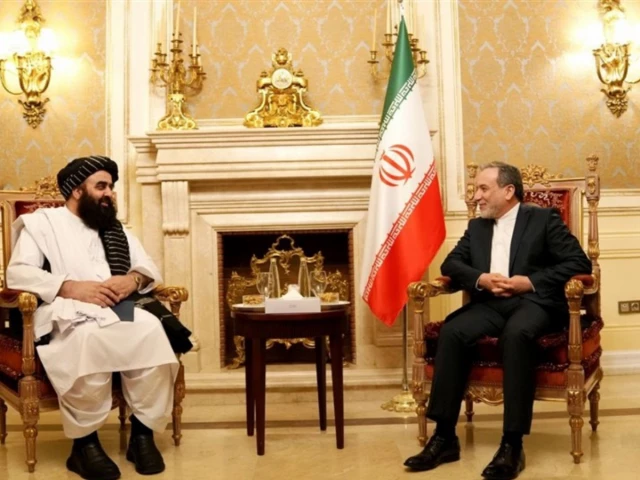
TEHRAN: Iranian Foreign Minister Abbas Araghchi has expressed Tehran’s readiness to play a constructive role in reducing tensions between Pakistan and Afghanistan, stressing dialogue and regional cooperation as the only viable path toward stability, Tasnim News Agency reported.

According to the report, Araghchi said Iran is prepared to assist both neighbouring countries in resolving their differences and urged continued diplomatic engagement to prevent further escalation. He underscored that stability between Pakistan and Afghanistan is crucial for broader regional peace and security.

Tensions between Pakistan and Afghanistan escalated into sustained cross-border hostilities following a series of militant attacks and retaliatory strikes, prompting a sharp deterioration in relations between the two neighbours. The situation intensified after exchanges of fire along the border and airstrikes targeting militant positions inside Afghanistan.

In response, Pakistan launched Operation Ghazab Lil Haq, a military campaign targeting terrorist networks along the Pakistan–Afghanistan border, particularly groups such as the Tehreek-e-Taliban Pakistan (TTP). Security sources describe it as a “precise and targeted” operation aimed at dismantling militant leadership, infrastructure, and logistics hubs, and maintaining that it will continue until its objectives are fully achieved despite diplomatic engagement.

Meanwhile, China also facilitated exploratory trilateral talks in Urumqi involving Pakistan, Afghanistan, and Chinese officials, aimed at reducing escalating tensions.

The engagement was described as preliminary and part of an existing trilateral mechanism rather than formal mediation, with both sides represented by foreign office, defence, and security officials. Pakistan used the discussions to press for verifiable action against militant groups operating from Afghan soil, insisting that verbal assurances alone would not be sufficient.

At the same time, China has continued to stress for high-level negotiations, with Islamabad reiterating its demand for “concrete, verifiable action” against cross-border terrorism. The talks are focused on addressing Pakistan’s core security concerns while managing ongoing hostilities and preventing further escalation, even as counterterrorism operations continue on the ground.

China has since stated that both sides have agreed to explore a “comprehensive solution” to the conflict and avoid steps that could further escalate tensions. The emerging framework reportedly includes border de-escalation, cooperation against militant groups such as the TTP, phased restoration of trade routes, refugee management, and improved communication mechanisms, with Beijing positioning itself as a facilitator to stabilise relations between the two neighbours.

Naqvi, Baker discuss efforts for second round of US-Iran talks in Islamabad

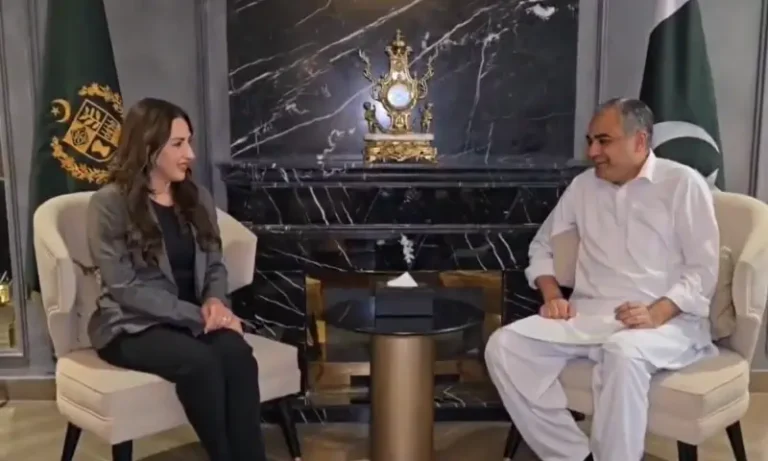
ISLAMABAD: Interior Minister Mohsin Naqvi met US Chargé d’Affaires to Pakistan, Natalie Baker, in Islamabad, where the two discussed ongoing diplomatic efforts to hold a second round of US-Iran talks, the interior ministry said.

According to the interior ministry’s statement, during their “important meeting”, Naqvi and Baker exchanged detailed views on the latest regional situation and discussed diplomatic efforts regarding the possible second round of US-Iran negotiations in Islamabad.

Naqvi commended US President Donald Trump’s initiative to extend the ceasefire, calling it a “welcome development” that made significant progress towards reducing tensions.

“We also hope for positive progress from Iran’s side,” the interior minister was quoted as saying.

The meeting emphasised the need for continuity in diplomatic channels for a lasting resolution to the conflict.

According to the ministry, the minister told Baker that Prime Minister Shehbaz Sharif and Chief of Defence Forces (CDF) Field Marshal Asim Munir were making “all-out efforts at every level” to resolve the issue.

“It is hoped that both parties will give a chance to a diplomatic and peaceful solution,” Naqvi said.

Uncertainty has prevailed over the prospect of parleys, with the arrival of the US negotiators to Islamabad having been put off on Wednesday and no confirmation by Tehran about its participation.

The second round of negotiations has been delayed due to continued friction between the two countries, particularly regarding Iran’s closure of the Strait of Hormuz and the US blockade of Iran’s ports.

As the ceasefire extension created space for further diplomacy, Trump on Wednesday hoped a second round of talks could take place within two to three days, despite persistent mistrust.

“It’s possible!” Trump reportedly told the New York Post by text message, after the newspaper reached out to him to confirm whether the talks were “expected in Islamabad within the next 36 to 72 hours”.

However, Iran’s foreign ministry spokesman Esmaeil Baqaei did not give a clear answer on resuming talks with the US.

When asked about the possibility of a second round of talks, Baqaei replied, “Diplomacy is a tool to secure national interests and security, and whenever we conclude that the necessary and logical groundwork is in place to use this tool for realising national interests and consolidating the Iranian nation’s achievements in frustrating enemies from achieving their sinister goals, we will take action.”

On Monday, the interior minister held separate meetings with the Baker and Iran’s Ambassador to Pakistan Reza Amiri Moghadam, to discuss arrangements for a second round of Islamabad Talks.

During his meeting that day, Naqvi informed Baker about the security measures taken for holding the talks, saying that “special security arrangements have been made for all our special guests”.

The first round of historic direct US-Iran talks was held in Islamabad on April 11 and 12, following a Pakistan-brokered ceasefire on April 8. It had ended without an agreement, but also without a breakdown.

PM meets Pakistanis chosen for China space mission, hopes to kickstart new era of space research

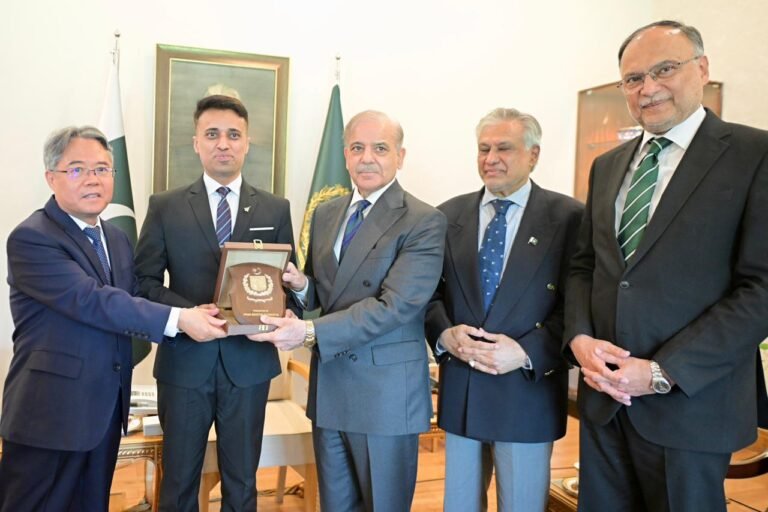
ISLAMABAD: Prime Minister Shehbaz Sharif on Thursday congratulated the two Pakistani astronaut candidates selected for China’s manned space programme, expressing hope that the voyage will “usher in a new era of space research in Pakistan”.

In a statement, the Prime Minister’s Office (PMO) said that he met the two candidates — Zeeshan Ali and Khurram Daud — at the Prime Minister’s House.

The premier congratulated the two, stating that the space mission was a “matter of pride for the entire nation”. He further commended their “round-the-clock efforts” in achieving the milestone.

PM Shehbaz hoped that the space mission would “add new dimensions to the brotherly relationship between Pakistan and China”.

Also present at the meeting was Chinese Ambassador to Pakistan Jiang Zaidong. The premier, in conversation with him, welcomed the development.

The prime minister told the Chinese ambassador that Pakistan and China’s friendship was “ready to reach for the stars and touch the heights of the sky”.

“Performing research duties in space for Pakistan is a source of honour, a unique privilege, and a matter of pride,” the PMO cited the astronaut candidates as saying, adding that the two hoped to “make every possible effort to live up to the nation’s hopes”.

A day earlier, China announced that it had selected two Pakistanis as candidates for its manned space programme.

Both will travel to China for training, and one of them will participate in a space flight mission as a payload specialist, according to CCTV, becoming the first foreign astronaut to board China’s space station.

China Daily reported that Zeeshan and Daud had passed multiple rounds of selection procedures and would soon visit China to take part in spaceflight training.

In February 2025, Pakistan’s Space and Upper Atmosphere Research Commission and China Manned Space Agency signed a cooperation agreement. Under the pact, two Pakistanis were to train in China, with one joining a mission on the Tiangong space station operated by Beijing.

In February this year, two astronauts were shortlisted for Pakistan’s Human Spaceflight Programme by the Astronauts Centre of China.

China has been barred from particip­ating in the International Space Station since 2011, when the US prohibited Nasa from collaborating with Chinese space agencies. Since then, Beijing has sought to build partnerships with other countries — including Pakistan — in its expanding space programme.

Pakistan dismisses Indian claims on Pahalgam attack, condemns “weaponised” false narrative

ISLAMABAD: Pakistan rejected Indian propaganda linking it to the 2025 Pahalgam attack on Thursday, deploring that the neighbouring country was focusing on “weaponising its false narrative” in the midst on an ongoing regional crisis.

The April 22, 2025 attack in Pahalgam saw 26 people, mostly tourists, killed in what is being described as the deadliest armed attack in the disputed Himalayan region since the year 2000. New Delhi blamed the attack on Pakistan without any evidence. For its part, Pakistan strongly denied the allegations and called for a neutral investigation.

On the attack’s one year anniversary, some in India appeared to link Pakistan again with terrorism. Meanwhile, the Indian army also said that a “response is assured” against acts of terrorism.

Subsequently, without referring to any particular instance, the Foreign Office (FO) in Islamabad said in a statement: “At a time when Pakistan, along with its international partners, is undertaking concerted diplomatic efforts for regional and international peace and security, it is deplorable that India has once again resorted to a campaign of baseless allegations and propaganda to link Pakistan with the Pahalgam incident.

“It is unfortunate that, in the midst of an ongoing regional crisis, India remains focused on weaponising its false narrative against Pakistan for narrow domestic political gains.”

The FO recalled the brief military conflict in May 2025 that followed the Pahalgam attack, saying: “After receiving a befitting reply to its misplaced adventurism in the form of Operation Bunyanum Marsoos last year, such allegations constitute yet another chapter from India’s playbook of creating a smokescreen for its continued sponsorship of terrorism across the region.”

It said fact remained that such propaganda campaigns could not distract the international community’s attention from India’s continued occupation of Kashmir and its denial of the right to self-determination to the Kashmiris, in violation of relevant UN resolutions.

“Nor can such gimmicks conceal the fact that India continues to undermine regional peace and security by resorting to inflammatory rhetoric, repeated provocations, and aggressive military posturing, including its illegal unilateral action to hold the Indus Waters Treaty in abeyance, in clear violation of international law,” the FO added.

It expressed hope that the international community would call on India to demonstrate responsible behaviour and to refrain from all rhetoric and actions that may serve as a spoiler to ongoing efforts aimed at regional and international peace and security.

Two days after the Pahalgam attack, India had taken a series of aggressive measures against Pakistan, including unilaterally suspending the critical Indus Waters Treaty (IWT). Pakistan retaliated by suspending all kinds of trade, closing its airspace for Indian flights and shutting down the Wagah border.

Subsequently, New Delhi launched deadly overnight air strikes on Pakistan on May 6 over allegations about the Pahalgam attack. In retaliation, Pakistan Air Force downed five Indian jets, later raising the tally to seven.

After tit-for-tat strikes on each other’s airbases, it took American intervention on May 10 for both sides to finally reach a ceasefire.

UK envoy lauds Pakistan’s role in bringing US, Iran to talks

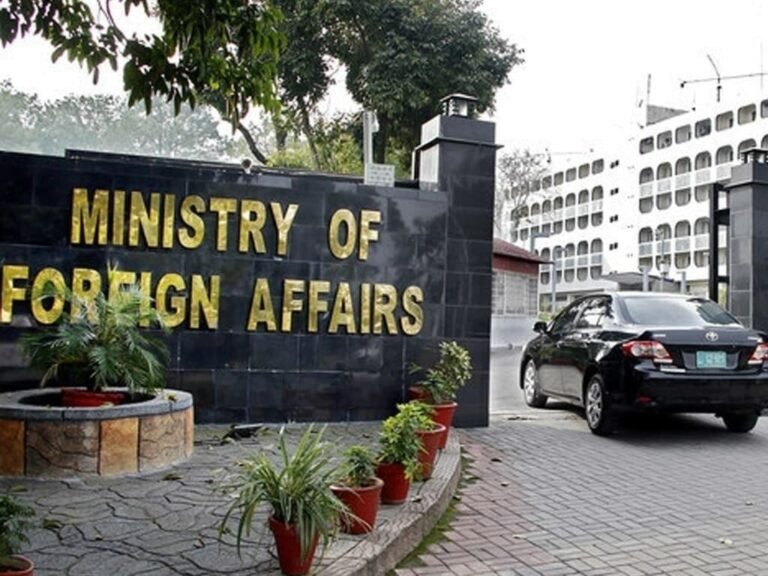
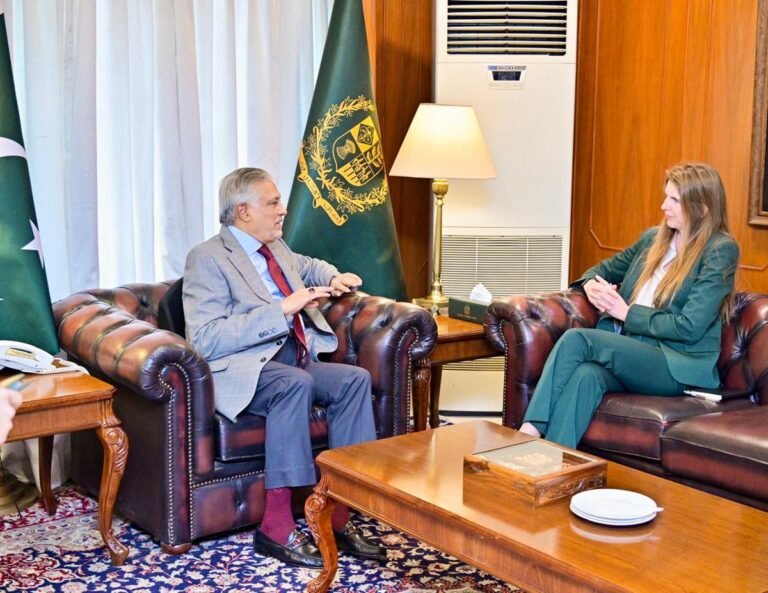
ISLAMABAD: British High Commissioner Jane Marriott on Wednesday praised and supported “Pakistan’s facilitative role in bringing the US and Iran to the negotiating table” during a meeting with Deputy Prime Minister and Foreign Minister Ishaq Dar.

According to a statement shared by the Ministry of Foreign Affairs (MOFA) on X, both sides discussed the evolving regional situation, while “FM Dar underscored Pakistan’s ongoing efforts to facilitate engagement and emphasised the importance of dialogue and diplomacy in the peaceful resolution of disputes.”

The British envoy “appreciated and supported Pakistan’s facilitative role in bringing the US and Iran to the negotiating table,’ the statement added.

Dar also spoke with Turkish counterpart Hakan Fidan.

Both leaders exchanged views on the latest regional developments and reaffirmed the importance of dialogue and diplomacy in peaceful settlement of disputes.

FM Dar has received unprecedented international recognition for his diplomatic leadership, as Pakistan positioned itself at the centre of high-stakes mediation efforts during the escalating Iran-US-Israel crisis.

Over the past week, senior officials and influential voices from more than ten countries, including Saudi Arabia, Iran, the US, China, Turkey, Azerbaijan, Bahrain, and Uzbekistan, have publicly acknowledged Dar’s role in facilitating ceasefire negotiations.

Pakistan emerged as a central facilitator in the sensitive diplomatic track, positioning itself as an “honest broker” amid sharply polarised positions between Washington and Tehran.

After 40 days of airstrikes, US and Iranian negotiators opened talks in Islamabad earlier this month following a two-week ceasefire brokered by Prime Minister Shehbaz Sharif. Last night, US President Donald Trump announced an extension of the ongoing ceasefire with Iran at the request of PM Shehbaz and Chief of Army Staff and Chief of Defence Forces, Field Marshal Asim Munir.

When American and Iranian negotiators met last weekend in Islamabad, the US proposed a 20-year suspension of all Iranian nuclear activity, while Iran suggested a halt of three to five years, according to people familiar with the proposals.

Iranian envoy meets PM Shehbaz, discusses regional situation

ISLAMABAD: Iranian Ambassador Reza Amiri Moghadam called on Prime Minister Shehbaz Sharif on Wednesday and discussed the ongoing regional situation following the extension of the ceasefire between the United States and Iran.

Last night, US President Donald Trump announced an extension of the ongoing ceasefire with Iran at the request of PM Shehbaz and Chief of Army Staff and Chief of Defence Forces, Field Marshal Asim Munir. In a post on Truth Social, Trump said the truce, which was set to expire within hours, would remain in place until Iran submits a comprehensive plan and negotiations reach a definitive outcome.

According to the Prime Minister’s Office, during today’s meeting, the discussion focused on the ongoing regional situation and peace efforts.

A day earlier, Moghadam met with Interior Minister Mohsin Naqvi. Both sides emphasised the need for a sustainable solution through diplomatic and negotiation channels to reduce regional tensions.

Pakistan emerged as a central facilitator in the sensitive diplomatic track, positioning itself as an “honest broker” amid sharply polarised positions between Washington and Tehran.

After 40 days of airstrikes, US and Iranian negotiators opened talks in Islamabad earlier this month following a two-week ceasefire brokered by PM Shehbaz.

Since the start of the war, multiple meetings have been held between the Pakistani and Iranian leadership, during which both sides discussed negotiations and regional peace.

Most notably, PM Shehbaz met with the Iranian delegation on April 11, during the “Islamabad Talks”. During the meeting, the premier affirmed Pakistan’s sincere resolve to continue its mediatory role, expressing the sentiment to Parliament Speaker Bagher Ghalibaf and Foreign Minister Abbas Araghchi.

On April 15, CDF Munir arrived in Tehran, along with Naqvi, as part of Pakistan’s ongoing peace efforts. The army chief, who concluded his visit on April 18, called on the top Iranian leadership.

On April 16, Naqvi met his Iranian counterpart Eskandar Momeni, reaffirming Pakistan’s commitment to regional stability, stressing that the country’s foreign policy is rooted in the pursuit of peace.

Ceasefire extended again at request of PM Shehbaz, CDF Munir: Trump

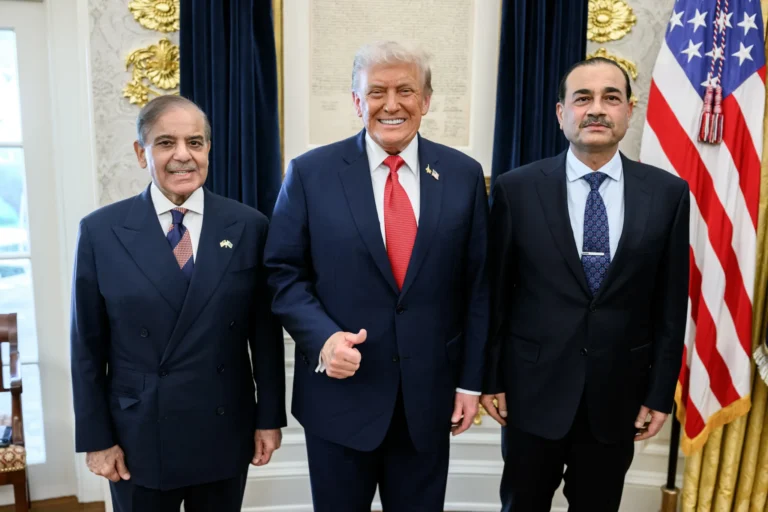
ISLAMABAD: United States President Donald Trump on Wednesday extended the ceasefire with Iran again upon the request of Field Marshal Asim Munir and Prime Minister Shehbaz Sharif, saying it would remain in place until the Islamic republic’s proposal was submitted.

In a post on Truth Social, Trump said the decision had been taken in the context of the situation in Iran and at the request of the Pakistani leadership.

“Based on the fact that the government of Iran is seriously fractured, not unexpectedly so and, upon the request of Field Marshal Asim Munir, and Prime Minister Shehbaz Sharif, of Pakistan, we have been asked to hold our attack on the country of Iran until such time as their leaders and representatives can come up with a unified proposal,” he said.

He added that he had directed the US military to maintain its preparedness while continuing the blockade.

“I have therefore directed our military to continue the blockade and, in all other respects, remain ready and able, and will therefore extend the ceasefire until such time as their proposal is submitted, and discussions are concluded, one way or the other,” Trump said.

PM Shehbaz responded to Trump in a post on X and offered thanks.

“On my personal behalf and on behalf of Field Marshal Syed Asim Munir, I sincerely thank President Trump for graciously accepting our request to extend the ceasefire to allow ongoing diplomatic efforts to take their course.

“With the trust and confidence reposed in, Pakistan shall continue its earnest efforts for negotiated settlement of conflict.

“I sincerely hope that both sides will continue to observe the ceasefire and be able to conclude a comprehensive ‘Peace Deal’ during the second round of talks scheduled at Islamabad for a permanent end to the conflict,” he said.

Earlier, Information Minister Attaullah Tarar said that a formal response from the Iranian side regarding the confirmation of the delegation to attend the Islamabad “Peace Talks” was still awaited.

In a post on X, Tarar mentioned that Pakistan, as the mediator, was in constant touch with Iran and was pursuing the path of diplomacy and dialogue.

“The ceasefire ends at 4:50am PST on April 22, and a decision from Iran to attend the talks before the end of the two-week ceasefire is critical,” he said.

Tarar further stated that Pakistan had made sincere efforts to convince the Iranian leadership to participate in the second round of talks, and these efforts were ongoing.

Shortly after, Iran’s foreign ministry spokesperson Esmaeil Baghaei told state TV that the country had not yet made a decision to attend talks with the US in Pakistan.

“US moves against two Iranian vessels amounted to ‘piracy at sea and state terrorism’,” Baghaei told state TV.

At the same time, the US delegation’s planned departure for Pakistan for the second round of face-to-face talks with Iran was delayed due to “additional policy meetings” in Washington, according to US media reports.

Vice President JD Vance, who is expected to travel to Islamabad, remained in Washington to attend the meetings at the White House, said a US official, according to The New York Times.

A White House official cited by The Washington Post said the departure was postponed for “additional policy meetings” involving Vance, without specifying a new timeline.

Pakistan gets $1bn Saudi inflow as second tranche of $3bn deposit

KARACHI: The State Bank of Pakistan (SBP) confirmed on Tuesday that Pakistan has received $1 billion from the Kingdom of Saudi Arabia.

“State Bank of Pakistan has received funds of US$1 billion from Ministry of Finance, Kingdom of Saudi Arabia in the value date of 20April2026.”

The central bank said this is the second tranche of the $3bn deposit recently agreed by Saudi Arabia.

The first tranche of $2bn was transferred last week.

The development came following Prime Minister Shehbaz Sharif’s visit to Saudi Arabia to push diplomatic efforts to promote peace in the Middle East.

On Friday, the kingdom pledged an additional $3bn in deposits for Pakistan and extended its existing $5bn facility for a further three years.

Pakistan will reportedly return a $3.5bn loan to the UAE this month, putting pressure on its reserves and risking breaches of its International Monetary Fund (IMF) programme targets.

The development comes at a sensitive time for the country’s external account position, which is already under strain from rising global oil prices and economic spillovers linked to tensions in the Middle East.

According to official figures, Pakistan’s foreign exchange reserves stood at $16.4bn as of March 27, sufficient to cover close to three months of imports. However, the repayment requirement from the UAE has added fresh pressure on the country’s external buffers.

In March, Islamabad failed to secure an agreement with the UAE to roll over the $3.5bn facility, marking the first such failure in seven years and raising concerns about near-term financing gaps.

Pakistan’s foreign exchange position, though under pressure, remains part of a broader stabilisation effort under IMF-supported reforms.

Analysts say external financing risks remain a key vulnerability, particularly amid volatile energy prices and constrained global capital markets.

PML-N focused on development ahead of GB polls, says Nawaz

LAHORE: PML-N President Nawaz Sharif on Tuesday vowed that, if elected, the party would focus on development in Gilgit-Baltistan (GB).

The remarks come ahead of the GB Assembly elections scheduled for June 7, with other parties also ramping up their preparations. Nawaz made the comments in a televised address to the PML-N’s parliamentary board for GB, where he highlighted past projects launched by the party in the region.

He said Prime Minister Shehbaz Sharif, his younger brother, had the “same passion” for developing GB as him, noting that the region had massive potential.

The former premier highlighted road projects “worth $60-$65 billion”, adding that “24-hour journeys were reduced to 10 hours”. He recalled facing criticism for having a tunnel constructed in Chitral as it was sparsely populated.

Referring to the initiatives undertaken by PM Shehbaz during his time as the Punjab chief minister, and now by his daughter Maryam, Nawaz told the party members: “You should copy it, and all these things should be launched in GB as well.”

The PML-N supremo said: “He (Shehbaz) launched numerous projects during his time. Look at him, find out about them. […] And now Maryam has taken the responsibility to take his work forward, so see what is happening there. You should copy it.”

In a message to all the PML-N candidates, Nawaz said, “When your candidates are elected, God-willing, they must have this in mind that they have been elected for service, not for fun.”

He further said that if the party formed a government in GB, he would invite the regional leadership. “You may call Shehbaz Sharif sahib, I will also come with him. All of us sitting here will come, and will make efforts to resolve your issues.”

Nawaz asserted that GB “is as dear to me as the rest of Pakistan is, and as Azad Kashmir, Punjab, Sindh, Balochistan and KP are”. Noting that both Centre and Punjab were active in development, he called on the rest of the provinces to do the same.

“Politics is not that elections happen and we approve candidates […] those [elected] should do something, not sit like kings and travel in government vehicles,” he said.

The PML-N supremo praised PM Shehbaz’s leadership and the roles played by Deputy PM Ishaq Dar and Chief of Defence Forces Field Marshal Asim Munir in recent weeks on the diplomatic front.

“These are historic roles,” he said.

During his address, Nawaz also urged the GB government to find ways to generate funds itself, instead of “only looking towards the federal government” for support.

“People from around the world want to visit Skardu and Hunza, so you should also put in some part in that,” he said, highlighting the region’s potential for tourism.

“Your budget should not only go into people’s pockets but also be used on the ground [for public],” the ex-PM emphasised.

He noted that the current economic situation was “not good”, with rising oil prices due to the Middle East conflict and development funds being pooled into absorbing the resulting economic shock.

However, the PML-N president pledged that any lack of funds would be provided by the Centre.

“Whatever we can do, we will provide it to you. I will be your biggest advocate. I will take money from Shehbaz sahib and give it to you.”

Stating that constructing motorways was “no favour”, he asserted: “Whether it is the development field, political field, or defence field, we have strongly fulfilled our role.

“Who knows GB more than PML-N? You all yourself are an example of the services we have rendered,” Nawaz remarked.