
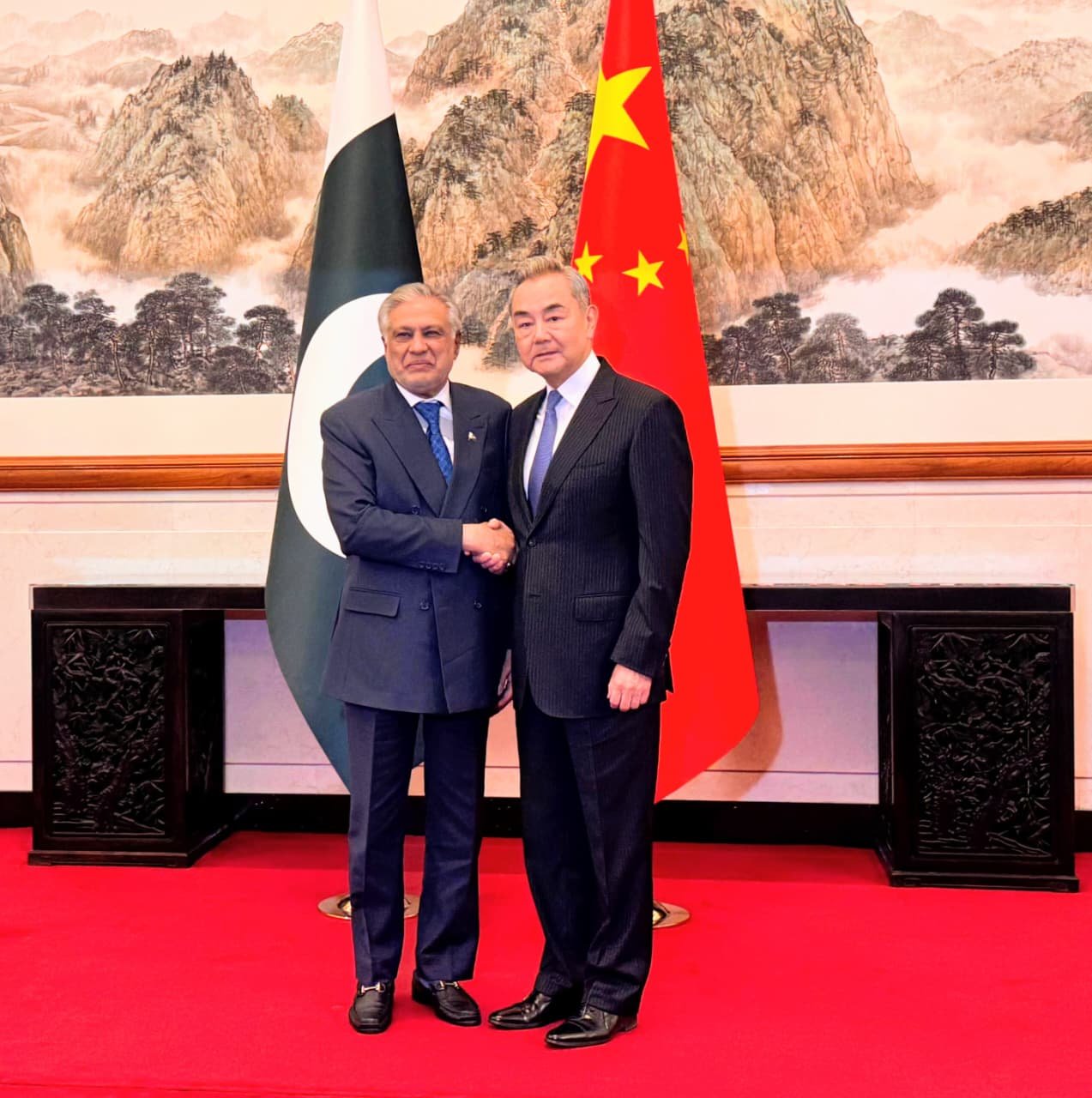
ISLAMABAD: Pakistan and China on Tuesday jointly rolled out a comprehensive five-point initiative aimed at restoring peace and stability in the Gulf and the wider Middle East, as the ongoing US-Israel war on Iran continues to escalate and threaten regional security.
The proposal was announced during Deputy Prime Minister and Foreign Minister Ishaq Dar’s one-day visit to Beijing, where he held detailed talks with Chinese Foreign Minister Wang Yi on the rapidly evolving situation in the region.
According to a statement issued by the Foreign Office, both sides expressed deep concern over the intensifying conflict and agreed that an immediate ceasefire was critical to prevent further escalation. They urged all parties to exercise maximum restraint and prioritise diplomatic engagement over military confrontation.
A key component of the initiative was the urgent call to launch peace negotiations without delay. Pakistan and China stressed that dialogue and diplomacy remained the only viable path to resolving the crisis and ensuring long-term stability in the region. They emphasised that sovereignty, territorial integrity, and national independence of all states, including Iran and Gulf countries, must be fully respected.
The two countries also highlighted the importance of protecting civilians and non-military infrastructure. They called on all sides to strictly adhere to international humanitarian law and immediately halt attacks on civilian populations, energy installations, desalination plants and nuclear facilities, warning that such strikes could have catastrophic humanitarian and environmental consequences.
Another major concern raised in the joint initiative was the security of global shipping routes, particularly the Strait of Hormuz, through which a significant portion of the world’s energy supplies passes. Both nations urged all parties to ensure the safety of commercial vessels and crew, facilitate the smooth flow of trade, and restore normal maritime operations as soon as possible to prevent a global energy crisis.
In addition, Pakistan and China underscored the need to strengthen multilateral cooperation under the framework of the United Nations. They called for renewed international efforts to build a comprehensive peace framework grounded in the principles of the UN Charter and international law, aimed at achieving a durable and lasting resolution to the conflict.
Earlier, China reaffirmed its commitment to closely coordinate with Pakistan on the Iran situation, with its foreign ministry describing both countries as “all-weather strategic partners” working together to promote peace.
The initiative comes amid intensified diplomatic activity, with Pakistan increasingly positioning itself as a key mediator between Washington and Tehran. Officials say indirect communication between the two sides is ongoing, facilitated through coordinated efforts involving regional stakeholders.
Meanwhile, Iran’s Ambassador to Pakistan welcomed Islamabad’s proactive diplomacy, describing it as a constructive effort to de-escalate tensions and restore stability in a region facing one of its most volatile crises in recent years.
The joint move by Pakistan and China signals a growing push by regional and global players to shift the focus from conflict to negotiation, as fears mount over the wider implications of the war for global energy security, trade routes, and geopolitical stability.

