

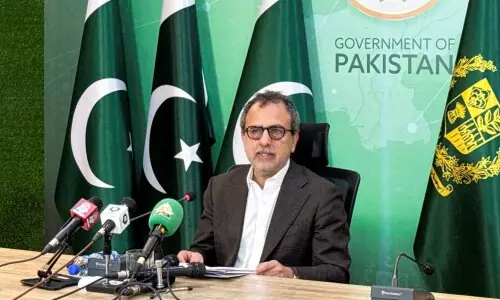
ISLAMABAD: Power Minister Awais Leghari on Thursday reiterated the government’s apology for excessive loadshedding, explaining that the external factor of the fuel supply crisis due to the Middle East war was one of the main reasons.
Addressing a press conference in Islamabad, Leghari reiterated the apology for higher than promised “load management”, which the government had blamed on lower water availability for power generation.
“If the public is facing any inconveniences due to us not providing electricity at night and during peak hours, I am directly answerable,” he said.
“We apologise too but […] the circumstances are such that they are not in our control. Even then, we ought to apologise,” the minister noted.
He said the country had a total shortfall of 4,000 megawatts (MW) due to two reasons: the shortage of fuel imports due to the ongoing Middle East war and reduced hydropower generation.
Leghari said the required liquified natural gas (LNG) “stopped coming from abroad after April 1”.
He pointed out that Qatar’s state-run energy firm had declared force majeure, which resulted in a “huge gap” in the power requirements fulfilled through gas plants during peak hours.
The minister recalled that the electricity generated from water resources was 3,200MW in April 2025, while the output from LNG plants was 3,000MW.
This year, he said, 3,200MW of hydropower was reduced to 1,671MW due to water not being released from Mangla and Tarbela.
The power minister said that the water from reservoirs was released only if the farmers needed it, and not solely for the purpose of generating electricity.
Leghari observed that the shortfall from LNG plants due to the lack of fuel imports was 2,500MW, whereas the shortfall in hydropower was 1,530MW, adding up to a total shortfall of over 4,000MW.
Speaking on the electricity demand, he said that in the first 15 days of April, the demand was 9,000MW at the minimum and 20,000MW at the maximum.
He asserted that there was and would not be loadshedding during off-peak hours, which are during the day, as there was no need for it.
“When the demand rises above 16,500MW, the power from gas plants is required. In the absence of gas, the country has no other fuel to fulfil its requirements,” the minister said.
He explained: “A shortfall occurs when the demand goes beyond 16,500MW after the consumption of every fuel resource in Pakistan — imported coal, local coal, nuclear, hydropower and solar power. And then in the evening, the loadshedding hours have to be increased as per the requirements.”
Leghari stated that one hour of loadshedding across Pakistan was implemented due to a shortfall of 500MW.
Commenting on social media comments referring to 40,000MW of installed capacity, the minister asserted that installed capacity “had no relation” with the ongoing situation.
“Installed capacity exists, which is why there was no load-shedding before April,” he contended.
The minister observed that the ongoing load management was primarily due to the Iran war.
He added that even if there was a major shortage of hydropower, LNG plants could have produced “6,000MW instead of 3,000MW” to make up for the hydropower shortfall and avoid a hike in electricity prices.
The minister said the government carried out load management last night in a “judicial manner, without differentiating between urban and rural Pakistan”.
He said that when the duration of loadshedding for the ordinary consumers exceeded three hours, the government then also began carrying out load management for industries over the past one to two days.
“In many areas of Pakistan, such as Hyderabad Electric Supply Company and K-Electric, which supply electricity to the south, there is no loadshedding. There is only economic loadshedding, which occurs every year and every time due to losses, but no addition to that has been made,” Leghari said.
The minister further said that the decision of two hours of daily loadshedding had been made to keep electricity prices in control.
Responding to a query, Leghari said that the government was trying to arrange more gas supplies, but the preference was to do so through the government’s contracts rather than on the spot market.
A day ago, Petroleum Minister Ali Pervaiz Malik told Reuters that Pakistan was considering buying LNG on the spot market to offset supply disruptions caused by the Iran war, but would favour government-to-government deals.
“We have made a lot of efforts on the diplomatic front as well,” he highlighted.
During his press briefing, Leghari asserted that the PML-N government in 2017 and over the past few years had “freed the entire public from darkness and loadshedding”.
He noted that Pakistan’s shift to renewable energy had been acknowledged in the international media, adding that it was “through the investments made by people, not with the support of IPPs (independent power producers) and expensive loans”.

