

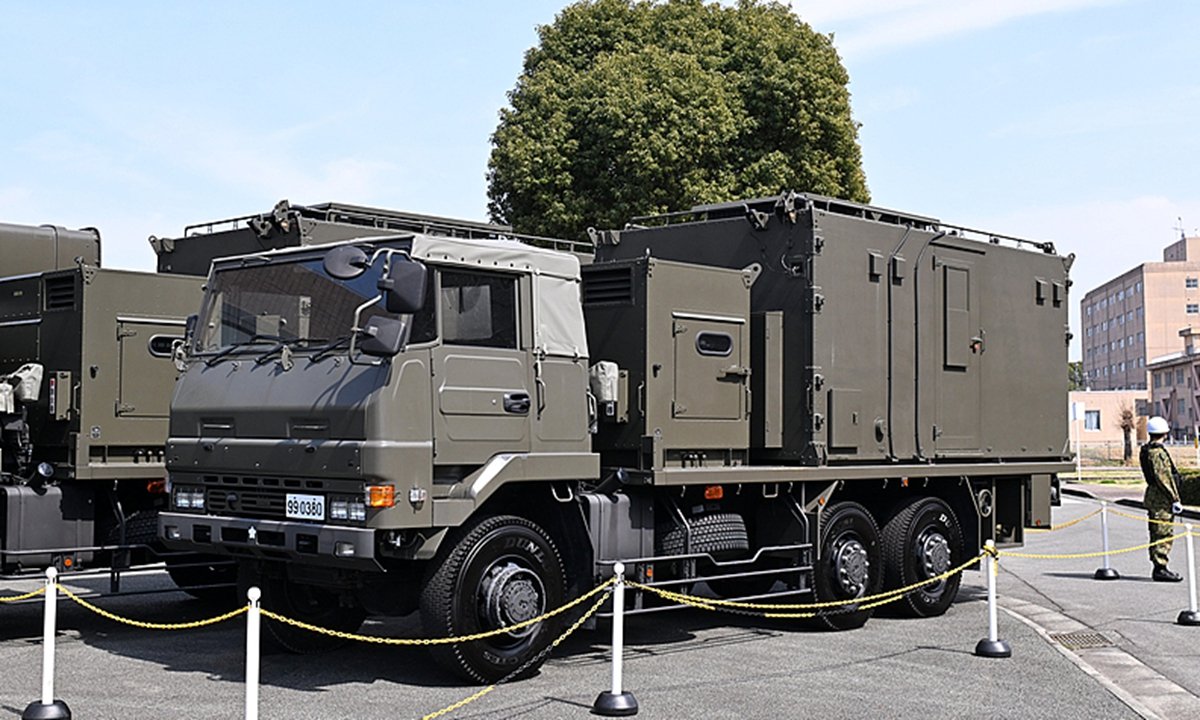
BEIJING: Standing behind temporary barricades outside the Japan Ground Self-Defense Force’s (JGSDF) Camp Kengun in Kumamoto on Tuesday, a group of Japanese protesters hoisted placards bearing a firm message: “We don’t need missiles.”
The demonstration marks a flashpoint in a fiercely debated pivot in Japan, as Tokyo is deploying long-range missiles under Japan’s so-called enemy base strike capabilities—a controversial expansion of military power that stretches the historical limits of its pacifist constitution.
According to the Asahi Shimbun, the newly deployed arsenal includes the upgraded Type 12 surface-to-ship missile, a weapon boasting a 1,000-kilometer range that is capable of reaching China’s coastal areas and waters around the Taiwan island, and the Hyper Velocity Gliding Projectile for island defense at Camp Fuji in Shizuoka.
Experts said that the deployment far exceeds Japan’s defense needs, violates the “exclusively defense-oriented” principle and its underlying strategic intent poses a significant security risk to neighboring countries.
Rising risks
According to a post by JGSDF on Tuesday, both weapons were given new official names, the Type-25 Surface-to-Ship guided Missile (25SSM) and Type-25 Hyper velocity Gliding Projectile (25HGP).
Japan has acquired such enemy base attack capability for the first time, Kyodo News reported on Tuesday, adding that the move aims “to strengthen the so-called deterrence against China.”
If Japan determines that the enemy has begun an armed attack, it may exercise the capability even before any damage occurs. However, if the judgment is mistaken, there is a risk that the action could constitute a preemptive strike prohibited under international law, per the report.
This also marks a major turning point in Japan’s defense policy, which has long been based on Japan’s “exclusively defense-oriented policy,” Asahi Shimbun claimed.
Both types of weapons are highly destructive, with the 25HGP posing a more pronounced threat due to its stronger penetration capability, Chinese military affairs expert Song Zhongping told the Global Times. He noted that even though the 25SSM is a high-subsonic system, it still boasts considerable strike capacity. “At a minimum, Japan’s strategic intent behind these developments poses a substantial security risk to neighboring countries,” Song added.
The 25SSM, which also features a stealth design and terrain-matching guidance, enables precise strikes against land targets, far exceeding Japan’s defensive requirements, said Xiang Haoyu, a distinguished research fellow at the China Institute of International Studies.
As for their locations, Xiang said the coverage of Camp Kengun and Camp Fuji together forms an “east west pincer posture.” This combination of range and deployment is clearly targeted at neighboring countries. Acting offensively under the pretext of defense, it marks a fundamental shift in Japan’s post-war security policy from defense-oriented to offensive, the expert noted.
In 2022, Japan revised its three key security documents, including the National Security Strategy and the National Defense Strategy. The updated policies formally introduced the concept of “counterstrike capabilities” – the ability to strike enemy missile launch sites or other military targets if Japan comes under attack, a report by The Diplomat noted.
Notably, while Japan’s Defense Minister Shinjiro Koizumi announced the deployments and their new names on Tuesday, dozens of citizens protested in front of the main gate of Camp Kengun, holding placards that read “We oppose the deployment” and “We don’t need missiles,” Kyodo News reported.
There was no explanation from the Defense Ministry to local residents regarding the transport-in, and participants complained that it was “an outrageous act like a surprise attack,” per the report by Kyodo News.
“Camp Kengun is situated in a residential area in the city center, 1.5 kilometers from the prefectural government office, adjacent to Kumamoto City Hospital, and only about 200 meters from my home,” Hideaki Takabayashi, a professor from a local university in Kumamoto, told the Global Times on Tuesday.
Takabayashi added that within a 2-kilometer radius of the camp, there are 29 childcare facilities, 12 elementary schools, seven junior high schools, eight high schools, and one university. “Deploying long-range missiles in such an area would naturally cause deep anxiety among local residents,” he said.
Takabayashi said that the local residents’ opposition stems not only from the extremely high security risks associated with deploying long-range missiles, but also from the fact that their deployment violates the Japanese Constitution.
Takabayashi stated that Japan’s Constitution defines national sovereignty, respect for fundamental human rights, and pacifism as the core principles of state governance. The deployment of long-range missiles threatens the basic human rights of people across Asia, including the Japanese people. Such an action openly violates the “exclusively defense-oriented” principle and constitutes a breach of the Constitution.
Xiang said that under the pretext of “self-defense,” Japan is pursuing military expansion at the cost of its own domestic security. Public concerns of becoming targets of attack are not unfounded worries, but a rational response to the government’s risky policies, the expert warned.
Rightward turning
Chinese observers have pointed out that the Japanese Self-Defense Force (SDF)’ deployment of new missiles has aroused grave concern, largely because it coincides with the increasingly blatant resurgence of a new form of militarism in Japan. This alarm is compounded by the recent incident in which a member of the SDF broke into the Chinese Embassy in Tokyo armed with a knife. With the SDF undergoing a clear rightward shift, there is a strong likelihood that they are becoming a vehicle for this emerging militarism. By breaching the long-standing “exclusively defense-oriented” principle, the potential danger is self-evident.
In recent months, Takaichi’s administration has invoked “regional threats” to advance military expansion and promote a revisionist view of history, and the incident involving the officer’s intrusion into the Chinese embassy has also exposed the infiltration of far-right ideology into the SDF, while historical revisionist education has distorted military values, Xiang said.
Following the latest development, in which the officer has been sent to prosecutors by the Japanese police, Chinese Foreign Ministry spokesperson Mao Ning noted on Tuesday that parents of the SDF officer who broke into the Chinese embassy said they saw no radical behavior while he was growing up and receiving education in his hometown, and they had no idea at all why he acted like this. But at the SDF, he received nine months of training for reserve officers.
“So the question is, during those nine months, what kind of views was he indoctrinated by the SDF and what kind of education did he receive?” Mao asked.

